Process Orchestration Execution Models: Deterministic, Dynamic, or Agentic?
A practical breakdown of deterministic, dynamic, and agentic process orchestration: when to use each model, key tradeoffs, and how n8n supports all three.
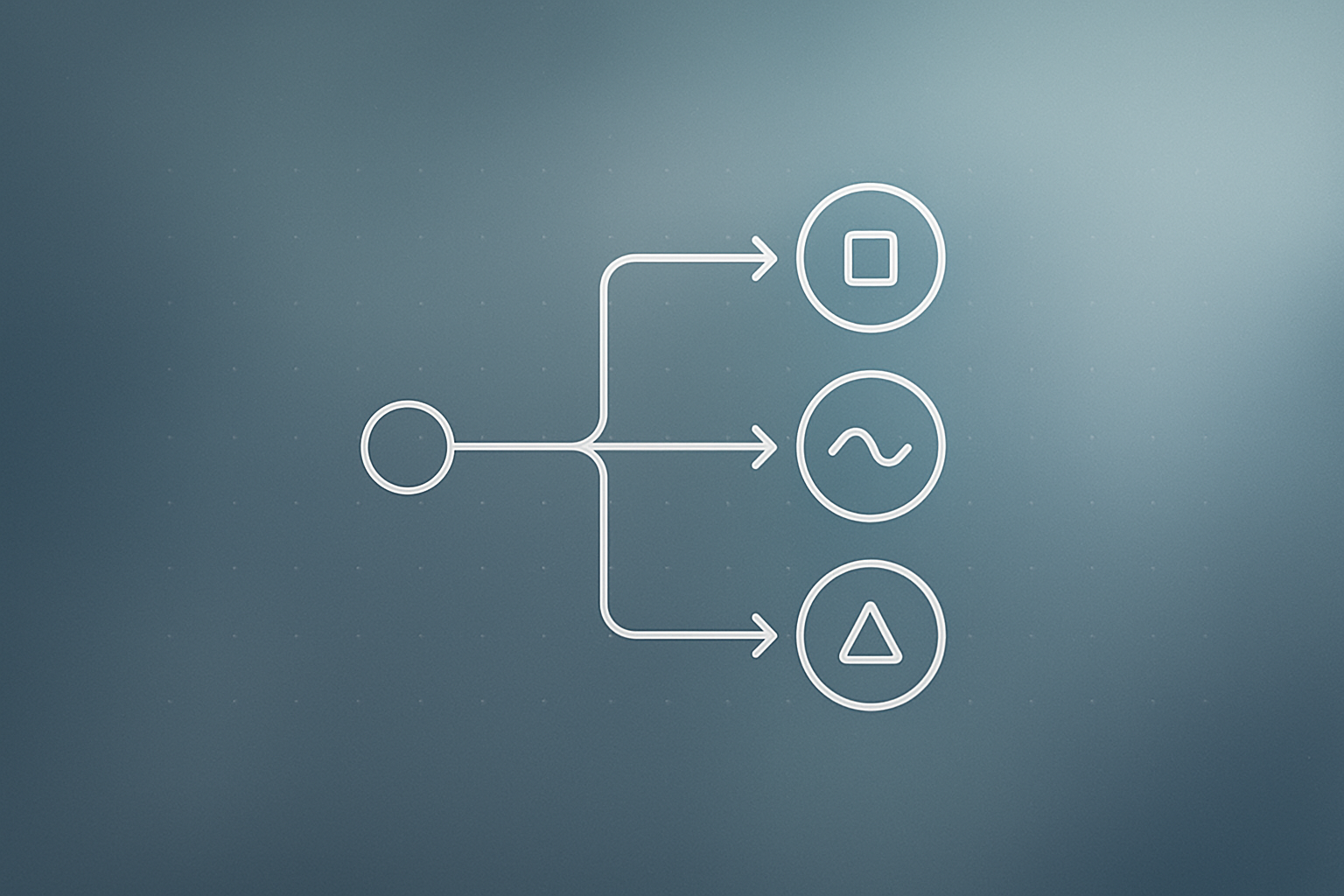
Process orchestration is a central control plane that coordinates people, systems, and tasks across a business workflow. But picking a platform is only half the decision. The execution model you choose, deterministic, dynamic, or agentic, determines how much runtime autonomy your orchestrator gets, and sets the rules for state management, failure isolation, and observability. n8n's blog breaks down when each model fits, and what you give up with each choice.
What happened
| Model | Key characteristic |
|---|---|
| Deterministic | Fixed graph, fully pre-mapped execution paths |
| Dynamic | Adjusts at runtime based on real-time conditions |
| Agentic | AI agents handle unstructured steps inside deterministic guardrails |
Process orchestration uses a workflow engine as its execution layer. Some platforms support Business Process Model and Notation (BPMN), a standardised notation that lets you model business logic and have the platform execute it directly. n8n, a visual node-based automation platform, takes a different approach: over 1,000 pre-built integrations plus a flexible HTTP Request node that connects tools without custom middleware.
Which processes actually need orchestration?
Not everything does. Simple, low-variance pipelines add coordination overhead without a meaningful return. According to n8n, orchestration earns its place when a process has:
- Dependencies on multiple endpoints (legacy systems, modern APIs, and human steps in the same flow)
- Multi-branch parallel execution or transaction compensation patterns
- Sophisticated exception handling for unresponsive external systems or malformed data
- Long-running state that persists for hours, days, or even weeks
That last point is often underestimated. If a workflow spans days and involves human approvals, something has to maintain state between those handoffs. In n8n, the Wait node and Execution history handle this, letting a workflow resume exactly where it paused.
How do the three execution models compare?
Deterministic orchestration
Every path is mapped before any execution starts. The orchestrator follows a fixed graph, which makes workflows auditable and predictable. This is the right model for compliance-heavy processes where you need a clear record of exactly what ran and when.
The tradeoff is brittleness. Anything outside the pre-mapped paths can trigger a failure, and your team either intervenes manually or builds custom exception logic to recover.
Dynamic orchestration
Instead of a fixed script, the orchestrator reads real-time conditions and readjusts the workflow continuously. This suits cloud and edge environments where workloads shift and resource constraints change mid-execution.
The cost is observability. Because decisions are decentralised and made at runtime, failures can cascade into downstream issues that standard monitoring tools struggle to trace. State management becomes a moving target rather than a known quantity.
Agentic orchestration
This model combines deterministic steps for predictable work with AI agents for unstructured or unpredictable tasks. The agents assess conditions and take actions without preset instructions, but they operate inside the guardrails of a larger deterministic workflow. In n8n, this is implemented through AI agent nodes embedded in a standard workflow graph.
The benefit over pure dynamic orchestration is transparency: the deterministic shell gives you a traceable structure even when the agent’s internal reasoning is less clear. According to n8n, you can improve agent explainability by configuring structured outputs that include the reasoning behind each decision. If you are exploring AI integration for your business processes, agentic orchestration is likely the model worth prototyping first.
Why it matters
The execution model is a more fundamental commitment than the specific workflow tool you pick. Retry semantics, failure isolation, and how you debug production incidents all flow from this choice. Switching models later means rearchitecting, not reconfiguring.
Businesses running multi-step processes with external APIs, payment systems, or human approvals are the most exposed to this decision. A deterministic model that cannot handle an API timeout gracefully will require manual intervention every time that edge case hits. An agentic model applied to a compliance workflow creates auditability gaps that regulators will notice. For a practical view of how automation choices play out in real projects, our client case studies show several examples where getting the workflow architecture right was the deciding factor.
Our take
The framing of “three execution models” is useful, but the boundaries blur fast in real implementations. Most production workflows we see are actually hybrids: a deterministic backbone with a few dynamic branches and, increasingly, one or two agentic steps for tasks like classification or summarisation.
The honest advice: start deterministic. Map every path. Build in explicit exception handling. Only reach for dynamic or agentic execution when the deterministic model demonstrably fails, not because the agentic version sounds more impressive. Agentic steps introduce a category of debugging complexity (why did the agent decide that?) that deterministic branches do not. Plan your observability before you ship, not after your first production failure.
If you are evaluating workflow automation platforms for a complex process, make sure the tool supports all three models. Locking into a platform that only does deterministic execution limits your options as process complexity grows.
What to do about it
- Audit your current workflows for complexity signals: long duration, external dependencies, conditional branches, human handoffs.
- Map every exception path before choosing an execution model. If you cannot map them, consider dynamic or agentic from the start.
- Prototype the simplest viable model first. Deterministic is easier to debug and audit.
- Add structured outputs and reasoning logs to any AI agent nodes before going to production.
- Define your observability strategy (execution history, alerting, retry policies) as part of the architecture, not as an afterthought.
The right execution model is the one your team can actually debug at 2am when something breaks in production.
Building an automation like this? Most client workflows we ship run on Make (referral link, it supports our reporting). If you would rather have it built and monitored for you, that is our workflow automation service.
Frequently asked questions
What is the difference between process orchestration and choreography?
Orchestration uses a central controller to coordinate all tasks and systems in a workflow. Choreography has no central controller; each service or component reacts to events from others. Orchestration is easier to observe and debug; choreography can be more resilient to individual failures.
When should I use agentic orchestration instead of deterministic?
Use agentic orchestration when parts of your workflow involve unstructured or unpredictable tasks that cannot be fully mapped in advance, such as classification, summarisation, or context-dependent decisions. Keep a deterministic shell around those agentic steps so the overall workflow remains auditable.
What is BPMN and do I need it for workflow automation?
BPMN stands for Business Process Model and Notation. It is a standardised way to diagram business process logic that some orchestration platforms can execute directly. You do not need it; tools like n8n use visual node-based interfaces instead, which achieve the same result without requiring BPMN expertise.
How does n8n handle long-running workflows that span days or weeks?
n8n provides a Wait node and an Execution history feature. The Wait node pauses a workflow and resumes it after a delay or trigger, while Execution history lets you track where a workflow is in its run. This keeps state intact across long durations and human-in-the-loop handoffs.