The Reflection Pattern: How AI Agents Self-Correct Before Responding
The reflection pattern lets AI agents generate, critique, and refine their own outputs. Learn how it works, its three variations, and when to use it.
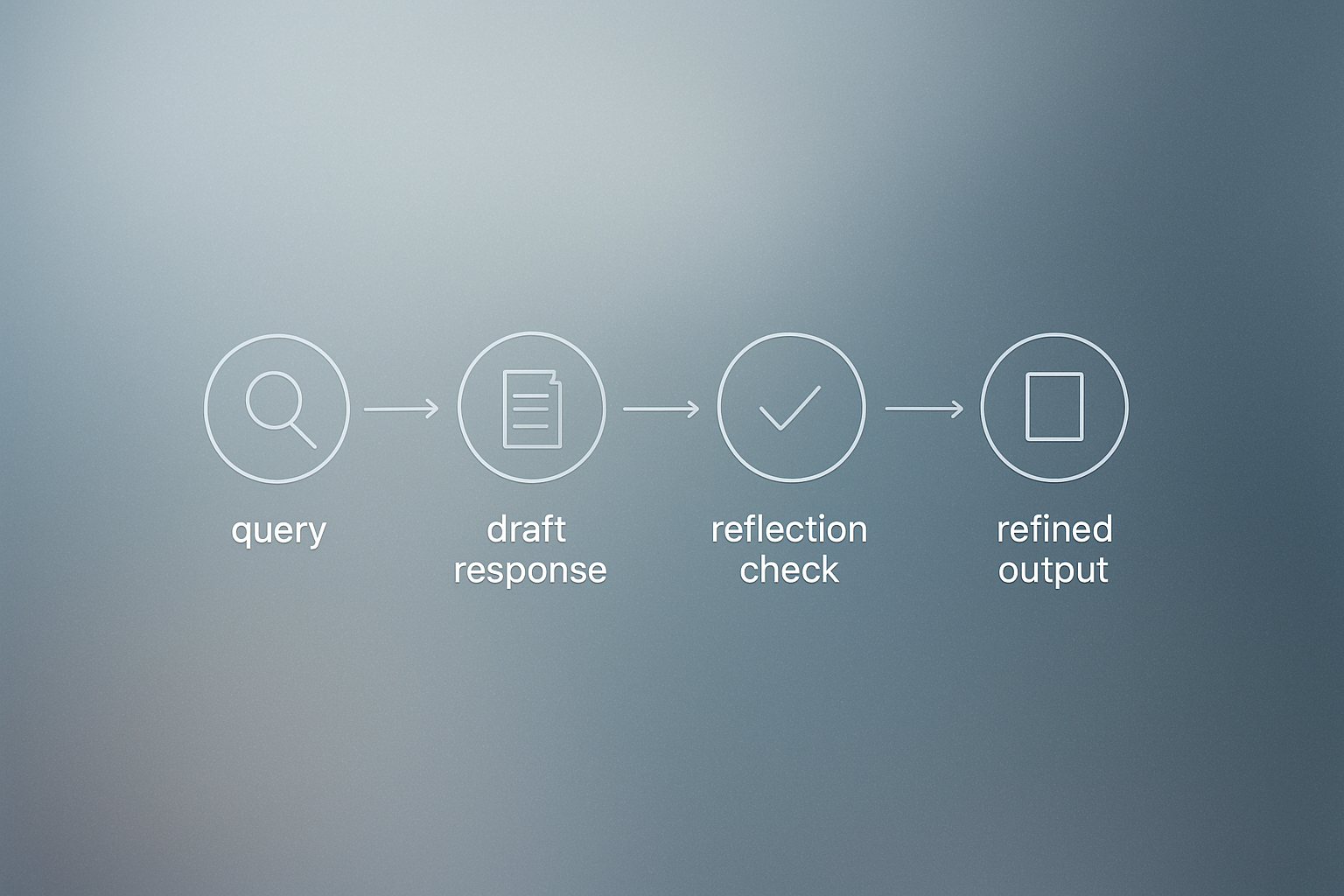
The reflection pattern is one of four recognized agentic AI design patterns, giving an AI agent the ability to generate an output, critique it against predefined standards, and revise it before the user ever sees a response. Originally documented alongside tool use, planning, and multi-agent collaboration, the pattern is gaining traction in production workflows built on platforms like n8n. It can meaningfully improve output quality for high-stakes tasks, but it comes with real latency and cost trade-offs that teams need to plan for.
What happened
| Fact | Detail |
|---|---|
| Pattern family | One of four agentic AI design patterns (tool use, planning, multi-agent collaboration, reflection) |
| Stages | Generate, Reflect, Refine |
| Variants | Single-model self-reflection, multi-agent reflection, tool-augmented reflection |
| Key risk without stopping criteria | Runaway token burn and quality degradation past the optimal response |
| Platform example | n8n (source-available, AI-native automation platform) |
The reflection pattern gives an AI agent a structured way to check its own work. Rather than returning the first answer a model produces, the agent holds that draft in a temporary state, runs a critique pass, and only delivers the output once it has gone through at least one revision cycle.
How the three-stage loop works
Every reflection pattern implementation follows the same core sequence, regardless of which variant you choose.
- Generate: The model creates an initial response, drawing on attached resources such as product documentation or company policies. This draft is held in a temporary state rather than sent to the user.
- Reflect: The same or a separate model critiques the draft against predefined criteria. In a customer support context, those criteria might include questions like “Did I consider all company policies?” and “Could this answer cause harm?” Flaws are cataloged for the next stage.
- Refine: The original draft and its critique are fed back into the generative model. The model revises the response, correcting errors and removing irrelevant content before the output is delivered.
One non-negotiable requirement: stopping criteria. Without a fixed iteration limit or quality threshold, an agent can loop indefinitely, burning through model tokens and potentially producing a worse answer than it would have after a single pass. A well-set stopping point reduces both computational cost and latency without sacrificing quality.
Which reflection variant should you use?
There are three practical variants, each with a different quality-versus-cost profile.
| Variant | How it works | Main limitation |
|---|---|---|
| Single-model self-reflection | One model acts as both generator and evaluator | Self-preference bias: may reinforce its own hallucinations |
| Multi-agent reflection | A second agent oversees the critique, functioning like peer review | Higher complexity and coordination overhead |
| Tool-augmented reflection | The model can invoke external tools (search engines, databases) during the critique stage | Accuracy depends on the quality of the external data source |
Single-model reflection is the simplest to implement but carries a meaningful risk: a model evaluating its own output is limited to its own internal reasoning, which means it can miss the same errors it made the first time around. According to n8n’s documentation, this is often called self-preference bias. Multi-agent reflection addresses this by introducing a distinct reasoning process for evaluation, similar to how code reviews catch bugs the original author overlooks.
Tool-augmented reflection goes further, letting the model reach out to a search engine or database when its internal knowledge is insufficient. This improves factual validation, but only as far as the external tool is accurate.
When does the reflection pattern actually make sense?
The pattern adds latency and cost at every iteration. It is worth it in some scenarios and wasteful in others.
Good fit:
- Output quality is the top priority and speed is secondary.
- There are clear, verifiable correctness criteria to check against (a checklist, a policy document, a schema).
- Single-pass outputs from your current setup frequently contain errors.
Poor fit:
- Low-latency responses are required (real-time chat, live search).
- The task is simple enough that a single well-prompted model pass is already reliable.
- Token budget is tight and the quality gain does not justify the extra cost.
For teams building on a visual workflow platform, n8n lets engineers chain multiple AI agent nodes, assigning one system prompt to generation and another to critique, connected through sub-workflows that manage the modular process. This kind of setup is also achievable through SDKs, but a visual interface makes it easier to track each stage and iterate faster.
If you are exploring how to wire AI agents into existing business processes, our AI integration services cover exactly this kind of agentic workflow design. For broader context on how orchestration models differ, see our earlier piece on deterministic, dynamic, and agentic process orchestration.
Why it matters
Most production AI failures are not caused by a bad model. They are caused by a single-pass architecture that has no mechanism to catch errors before they reach the user. The reflection pattern is a systematic answer to that problem.
As more businesses move from AI demos to AI in production, the gap between “it worked in testing” and “it works reliably at scale” is going to be filled by design patterns like this. Understanding which pattern fits which task is becoming a core skill for anyone building or commissioning AI-powered tools.
Our take
The reflection pattern is genuinely useful, but it is easy to over-apply. We have seen teams reach for multi-agent reflection because it sounds more robust, when single-pass prompting with tighter instructions would solve the same problem in a fraction of the time and cost. Before you build a reflection loop, ask whether your error rate actually justifies the added token spend and latency. If your single-pass outputs are already 90% reliable, a better system prompt will outperform a reflection pattern every time.
That said, for tasks with verifiable criteria (compliance checks, structured data extraction, customer-facing policy responses), a well-scoped reflection loop with a sensible iteration cap is one of the more practical reliability improvements available today. Just set your stopping criteria before you deploy, not after you get the token bill.
If you want to build this kind of agent into your workflow automation, start with single-model reflection, measure the quality delta, and only move to multi-agent if the numbers justify it. You can also talk to the Lumien team if you want a realistic assessment of whether this pattern fits your specific use case.
Building an automation like this? Most client workflows we ship run on Make (referral link, it supports our reporting). If you would rather have it built and monitored for you, that is our workflow automation service.
Frequently asked questions
What is the reflection pattern in AI agents?
The reflection pattern is an agentic AI design pattern where an agent generates an initial output, critiques it against predefined criteria, and refines it before delivering a final response. It is one of four recognized agentic design patterns alongside tool use, planning, and multi-agent collaboration.
What are the three stages of the reflection pattern?
The three stages are Generate (the model creates a first draft), Reflect (the same or a different model critiques the draft), and Refine (the draft and critique are fed back into the model to produce a corrected output).
What is the difference between single-model and multi-agent reflection?
In single-model reflection, one model acts as both generator and critic, which risks self-preference bias where it reinforces its own errors. In multi-agent reflection, a separate agent handles the critique, providing an independent reasoning process that is better at catching hallucinations or mistakes.
Why do AI reflection loops need stopping criteria?
Without a fixed iteration limit or quality threshold, a reflection loop can run indefinitely, consuming large numbers of model tokens and potentially degrading the output past its optimal point. Stopping criteria control cost, latency, and output quality.