Safari Lets You Build Extensions With Plain-English Prompts Using Apple Intelligence
Apple is adding AI-powered extension creation to Safari, letting users describe what they want and have Apple Intelligence generate a working extension automatically.
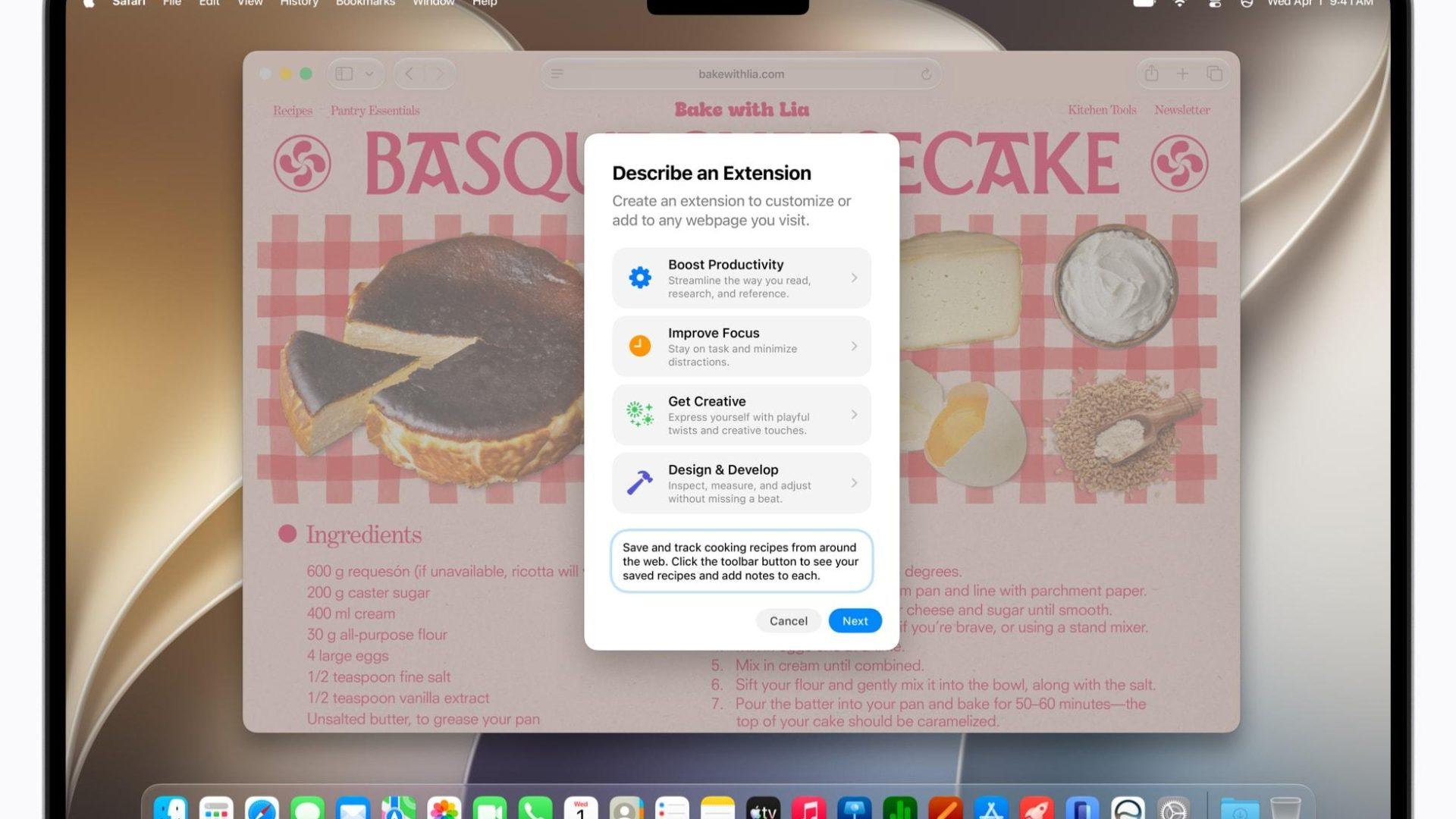
Apple has shown off a new Safari feature that uses Apple Intelligence to generate browser extensions from plain-text descriptions. In a demo, the company prompted Safari with a request to save and track cooking recipes from around the web, and the browser produced a working "Recipe Keeper" extension on the spot. The move is a direct response to one of Safari's oldest complaints: its extension catalogue is thin compared to Chrome and Firefox, largely because Apple's developer requirements have kept third-party builders away.
What happened
Apple demonstrated a new capability for Safari where users can describe a browser extension in plain language and have Apple Intelligence build it for them. The demo prompt read: “Save and track cooking recipes from around the web. Click the toolbar button to see your saved recipes and add notes to each.” Safari then generated a functional extension called “Recipe Keeper” based on that description alone.
The feature is designed to address a long-standing weakness. Safari’s extension library has stayed small because Apple imposes strict requirements on developers who want to publish extensions. That barrier has kept many useful tools exclusive to Chrome or Firefox.
Why it matters
For most users, the extension gap between Safari and Chrome is a real friction point. Ad blockers, productivity tools, and niche utilities have almost always appeared on Chrome first, and many never come to Safari at all.
By letting users generate their own extensions with a text prompt, Apple sidesteps the developer supply problem without having to open the doors to unvetted third-party submissions. The quality and security of AI-generated extensions is still an open question, but the approach is practical: if you need something that does not exist in the Safari extension store, you can try to build it yourself in seconds rather than switching browsers.
This also fits Apple’s broader Apple Intelligence rollout. Rather than licensing a general-purpose AI chatbot, Apple is weaving on-device AI into specific, task-focused features across its software. Safari extension generation is a concrete example of that strategy in action.
Our take
This is one of the more honest AI product moves we have seen lately. Apple is not claiming it solved the extension ecosystem overnight. It is handing users a practical workaround for a gap that has existed for years.
That said, a few things are worth watching carefully:
- Code quality. AI-generated browser extensions can introduce security risks if the output is not sandboxed or reviewed. Apple has not yet published details on how generated extensions are handled.
- Complexity limits. A recipe keeper is a simple, well-scoped task. Whether this works for anything more complex, like a multi-site price tracker or a custom content filter, remains to be seen.
- Portability. Extensions built this way presumably live on your device. If Apple ties the feature tightly to iCloud or Apple hardware, it further deepens the lock-in that already comes with using Safari.
For small business owners who rely on a specific browser workflow, this feature could be worth testing once it ships. But we would not retire your Chrome setup yet based on a demo alone.
What to do about it
If you manage a team that uses Macs and has ever wished Safari had a specific extension, write that wish down now as a plain-English description. When this feature becomes available, those descriptions are exactly the kind of prompt you will need. Keep them short, specific, and focused on one task per extension. That is how the demo was structured, and it is likely how the model performs best.