NVIDIA TensorRT Model Connect: Hugging Face to C++ Inference in Two Commands
NVIDIA's TensorRT Model Connect converts Hugging Face checkpoints to native C++ TensorRT inference in two CLI commands, no ONNX step required. Linux aarch64 only for now.
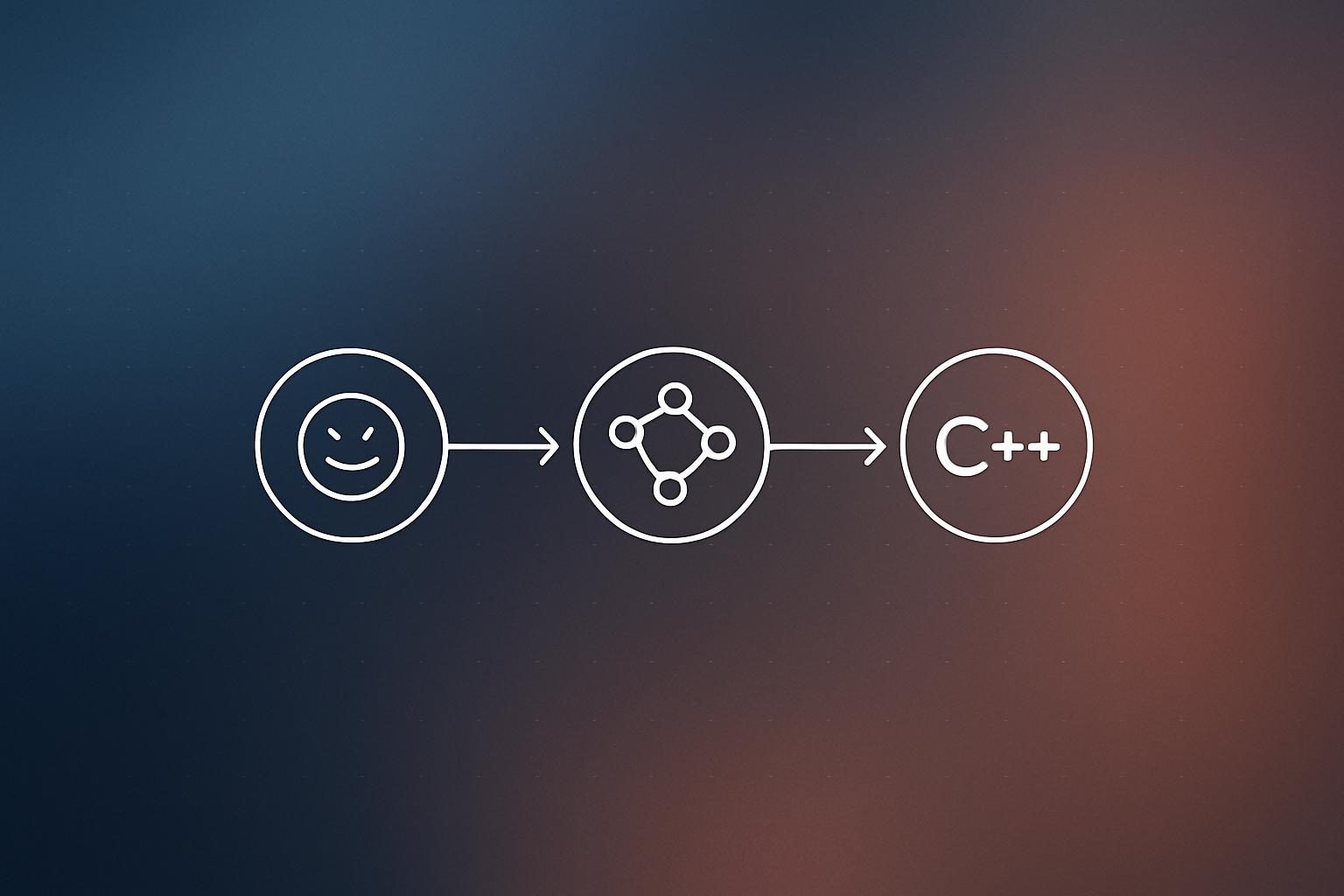
NVIDIA has released TensorRT Model Connect (TRTMC) in public preview, an open-source tool that converts a supported Hugging Face or local model checkpoint into a native C++ TensorRT inference bundle using just two CLI commands. There is no intermediate ONNX export step. The output is a versioned .bundle artifact that runs through native C++ task APIs, meaning inference can execute inside a C++ service, embedded system, or robotics stack without PyTorch present at runtime. Release wheels currently target Linux aarch64 only.
What happened
| Detail | Fact |
|---|---|
| Tool name | TensorRT Model Connect (TRTMC) |
| Status | Public preview |
| License | Apache-2.0 |
| Snapshot date | July 29, 2026 (GB300) |
| Profiles covered | 105 profiles across 76 model families |
| Profiles beating reference by 5%+ | 102 of 105 |
| Supported platforms (wheels) | Linux aarch64, Python 3.10 or 3.12, glibc 2.39+, TensorRT 11.1.0.106 |
| x86_64 support | Docker source-build path only |
NVIDIA’s conventional conversion route runs: PyTorch to ONNX or TorchScript, then to TensorRT, then into model-specific C++ integration code. TRTMC collapses that into two commands and a single artifact. The project ships as a collection of family-owned reference implementations rather than one generic converter, which means each supported model family gets its own tuned build path instead of a catch-all exporter.
How the two commands work
The quick-start example builds and runs Qwen3-0.6B at bfloat16 precision with a 16,384-token cache:
trtmc build Qwen/Qwen3-0.6B --precision bf16 --max-cache-length 16384 --output qwen3-0.6b.bundle
trtmc run ./qwen3-0.6b.bundle --prompt "What is the capital of France? Answer in one word." --chat-template --no-thinking
The same bundle loads into a C++ application with a single call to trtmc::load("./qwen3-0.6b.bundle"). From there, applications call task-level APIs: generate(), transcribe(), generate_image(), embed(), and solve(). No conversion stages, no per-model glue code.
What the .bundle actually is
The bundle is the handoff point between Python and C++. Python handles checkpoint resolution and TensorRT engine construction. The resulting artifact contains versioned engines and a manifest. A small number of hybrid profiles invoke a helper Python executable at runtime, and their manifests declare that dependency explicitly so it is not hidden. The trtmc inspect command exposes bundle kind, model family, precision, runtime identity, and engines, making the artifact auditable.
Who built it, and how
According to NVIDIA, the entire project, including model implementations, performance tuning, tests, integrations, and documentation, was built using OpenAI Codex agents under human direction and review. That is worth noting both as a signal of how NVIDIA is structuring internal AI-assisted development and as relevant context for evaluating code quality during a public preview.
Why it matters
The conventional ONNX export path breaks often. Operators not supported, shape inference failures, and repeated per-model patching add real engineering hours to every new model deployment. TRTMC removes the intermediate artifact entirely, which eliminates a whole class of export-gap bugs. For teams already running inference on NVIDIA hardware inside C++ pipelines, that is a meaningful reduction in integration overhead.
Target use cases according to NVIDIA include on-device text generation, speech recognition and synthesis, OCR and document parsing, embeddings for retrieval services written in C++, diffusion image and video generation, segmentation, and time-series forecasting. The industries where this matters most are robotics and autonomous machines, industrial inspection, automotive in-vehicle compute, medical devices, defense and aerospace edge systems, and media processing: anywhere inference must live inside a C++ binary rather than a Python server.
For teams interested in deeper AI integration into their products, the approach here connects to the broader pattern of embedding AI models directly into application stacks rather than wrapping them in separate Python services.
Our take
This is genuinely useful for a specific audience: teams that already own a C++ inference stack and are spending engineering time on the ONNX treadmill. The two-command pitch is real, not marketing math, because the hard work (per-family optimization, bundle versioning, C++ task APIs) is already done inside the tool.
That said, the caveats matter. Aarch64-only wheels mean most x86_64 development environments need the Docker build path, which adds friction for evaluation. Public preview with no tagged release is not a stable API. Regulated industries should treat this as a trial, not a production dependency, until a versioned release ships. And the Codex-built codebase deserves careful review before it lands in any security-sensitive stack.
Small teams shipping Python services get little from this today. The tool is built for platform teams and hardware-close engineers, not web API developers. If you are following NVIDIA’s AI tooling releases alongside the broader picture of how inference workloads are straining infrastructure, TRTMC fits into a clear trend: moving inference closer to hardware and further from interpreted runtimes.
What to do about it
- Check whether your target model family is in the 76 supported families before spending any time on evaluation.
- If you are on Linux aarch64 with TensorRT 11.1.0.106 and Python 3.10 or 3.12, install the wheel and run
trtmc inspecton a test bundle to validate the artifact before touching your production pipeline. - If you are on x86_64, clone the GitHub repo and use the Docker source-build path. Budget extra time for the build step.
- Do not standardize on TRTMC in a regulated or production environment until NVIDIA ships a tagged stable release.
- Run
trtmc inspecton any bundle before deployment to verify precision, engine identity, and runtime dependencies.
If your team needs help evaluating whether this fits your deployment architecture, talk to the Lumien team about what a C++ inference migration actually involves.
Frequently asked questions
What is TensorRT Model Connect (TRTMC)?
TRTMC is an open-source tool from NVIDIA, released in public preview, that converts a supported Hugging Face or local model checkpoint into a native C++ TensorRT inference bundle using two CLI commands, with no ONNX export step required.
Does TensorRT Model Connect work on x86_64?
Not via pre-built wheels. Release wheels currently target Linux aarch64 only with Python 3.10 or 3.12 and TensorRT 11.1.0.106. x86_64 users must build from source using the Docker path.
How many model families does TRTMC support?
The July 29, 2026 GB300 snapshot covers 105 profiles across 76 model families, with 102 of those profiles exceeding their declared performance reference by more than 5%.
Is TensorRT Model Connect production-ready?
It is in public preview and suitable for evaluation and native integration work. NVIDIA has not yet published a tagged stable release, so regulated or production environments should wait before standardizing on it.