NVIDIA DeepStream 9.1: 13 Agentic Skills and Cross-Camera 3D Tracking
NVIDIA DeepStream 9.1 ships 13 agentic skills, multi-view 3D object tracking across cameras, and automatic camera calibration. Here's what changed and why it matters.
NVIDIA released DeepStream 9.1 on July 18, 2026, updating its GPU-accelerated video analytics toolkit with 13 agentic skills for coding agents, up from 2 in version 9.0. The headline additions are Multi-View 3D Tracking (MV3DT), which assigns a single consistent object ID across multiple camera feeds, and AutoMagicCalib (AMC), which replaces manual camera calibration with an automated microservice. The release also adds JetPack 7.2 support for Jetson Orin and Thor edge hardware, plus a unified open-source GitHub repository under CC-BY-4.0 and Apache-2.0 licences.
What happened
| Detail | Value |
|---|---|
| Release date | July 18, 2026 |
| Agentic skills (v9.1) | 13 |
| Agentic skills (v9.0) | 2 |
| Sample datasets included | 4-camera and 12-camera MV3DT sets |
| New Jetson support | JetPack 7.2 (Orin, Thor) |
| Licence | CC-BY-4.0 AND Apache-2.0 |
DeepStream is NVIDIA’s streaming analytics toolkit built on GStreamer (an open-source multimedia pipeline framework). It runs multi-stream, multi-model inference on NVIDIA GPUs, combining hardware-accelerated decoding, TensorRT inference, object tracking, and message broker integration.
What changed between versions
| Capability | DeepStream 9.0 | DeepStream 9.1 |
|---|---|---|
| Agentic skills | 2 (deepstream-dev, import-vision-model) | 13 |
| Multi-camera 3D tracking | Not shipped as a skill | MV3DT skill and reference app |
| Camera calibration | Manual | AutoMagicCalib microservice |
| Jetson support | JetPack 7.1 GA | JetPack 7.2 (Orin, Thor) |
| Distribution | NGC packages and GitHub source | Unified GitHub monorepo |
How MV3DT tracks objects across cameras
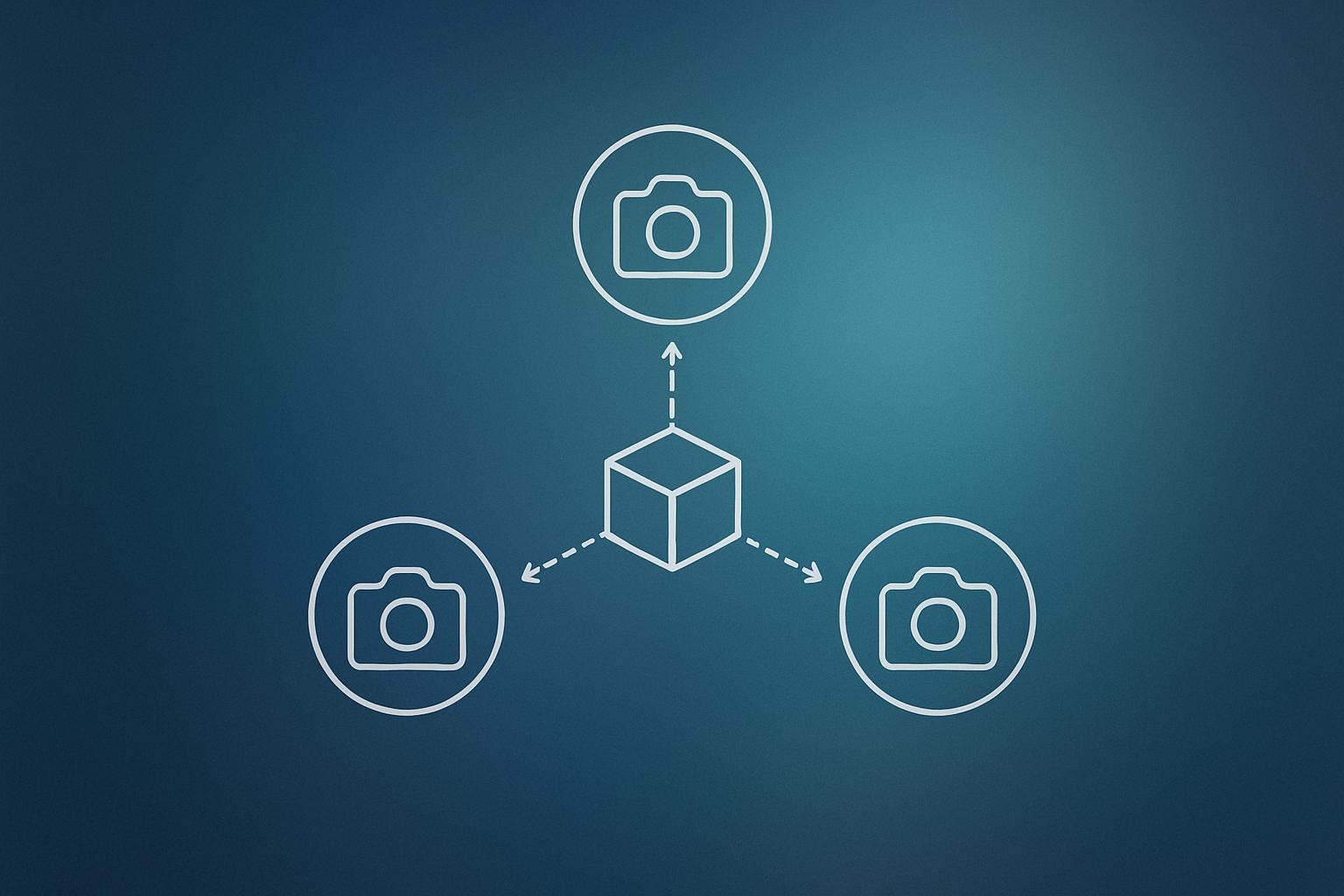
The core problem MV3DT solves is identity fragmentation: a person walking through a warehouse past four cameras typically gets four separate object IDs. MV3DT projects detections from each camera into a shared 3D world coordinate system and then associates observations of the same object across views, assigning one globally consistent ID.
The pipeline runs in four stages:
- Detection. Each camera stream runs one of three supported models: PeopleNetTransformer (transformer-based, default for pedestrian scenes), PeopleNet v2.6.3 (DetectNet_v2 architecture, high efficiency), or RT-DETR 2D (multi-class: pedestrians, transporters, and forklifts).
- Monocular 3D perception. A 3×4 projection matrix stored in a YAML calibration file back-projects 2D bounding boxes into 3D world-space coordinates using a ground-plane assumption.
- Multi-view association. Tracklets (short tracked trajectories) are shared between cameras via MQTT, a lightweight publish/subscribe messaging protocol. When two cameras see the same person, tracklets are matched by proximity in 3D world space.
- Output. Results appear as a tiled on-screen display with 2D and 3D bounding boxes, a bird’s-eye view trajectory map, and per-frame protobuf metadata delivered via Kafka (including sensor ID, object ID, and 3D bounding box).
How AutoMagicCalib removes the calibration bottleneck
MV3DT needs calibrated cameras, which traditionally means taking systems offline and using physical calibration targets. AMC sidesteps this by analysing tracked objects in existing video files or live streams. It estimates both intrinsic parameters (focal length, principal point, lens distortion) and extrinsic parameters (rotation, translation, world position).
The AMC pipeline runs five internal stages: per-camera trajectory extraction, single-view rectification, multi-view tracklet matching, bundle adjustment, and optional VGGT (Visual Geometry Grounded Transformer) refinement for scenes with limited object movement. Users only need to supply a layout image and a few alignment points through AMC’s web interface or REST APIs.
How developers deploy it using agentic skills
Rather than manually editing configuration files, developers describe intent in plain language and let a coding agent handle setup. The skills are compatible with Claude Code, Codex, Cursor, and similar agents. After cloning the DeepStream repository and copying the skills directory into the agent’s skills folder, a single natural language prompt such as “deploy mv3dt on the 12-camera sample dataset” triggers the full setup: container pull, Kafka and Mosquitto broker installation, model weight download, pipeline config generation, and tracking launch. If calibration files are absent, the AMC skills run automatically.
This kind of AI integration workflow, where agents handle infrastructure setup through natural language, is exactly where teams are starting to save meaningful engineering time in 2026. The agentic approach matters most when the configuration surface is large, which it certainly is in multi-stream video pipelines.
Why it matters
Multi-camera object tracking has been technically possible for years but operationally painful. Calibration downtime and per-camera ID fragmentation made it impractical for most deployments outside of well-funded research labs. AMC and MV3DT together reduce that barrier substantially.
The use cases NVIDIA points to are concrete: warehouse safety (tracking workers near forklifts across aisles), retail analytics (following shoppers between camera zones to measure dwell time accurately), smart-building occupancy counting, and robotics navigation. Each of these previously required significant custom engineering or expensive third-party solutions.
The move to a unified open-source monorepo under permissive licences also makes it easier for teams to fork, extend, and audit the code, which matters for regulated industries like logistics and building management.
For those tracking the broader trend of agentic AI handling infrastructure tasks, this sits alongside patterns we covered in our look at how AI agents are reshaping engineering scope decisions.
Our take
The jump from 2 to 13 agentic skills is a real expansion, not cosmetic versioning. The combination of AMC and MV3DT in a single prompt-driven workflow removes two of the three hardest parts of deploying cross-camera tracking (calibration and ID association). The third hard part, infrastructure reliability at scale, is still on the team building it.
The natural language deployment interface is useful for reducing the time from “we want to track people across our warehouse cameras” to a running demo. But anyone putting this into production still needs to understand the underlying MQTT and Kafka plumbing. The skills lower the floor, not the ceiling.
If you are evaluating video AI for a client in retail, logistics, or building management and want to understand what integration actually involves, talk to the Lumien team before committing to a stack.
Frequently asked questions
What is NVIDIA DeepStream 9.1?
DeepStream 9.1 is the latest version of NVIDIA's GPU-accelerated video analytics toolkit. It adds 13 agentic skills for coding agents (up from 2 in v9.0), a multi-camera 3D tracking skill called MV3DT, an automatic camera calibration microservice called AutoMagicCalib, and JetPack 7.2 support for Jetson Orin and Thor edge devices.
How does MV3DT track objects across multiple cameras?
MV3DT projects detections from each camera into a shared 3D world coordinate system using a 3x4 projection matrix. It then matches tracklets across cameras via MQTT messaging by comparing object positions in 3D space, assigning one consistent global ID to each object regardless of how many cameras see it.
What does AutoMagicCalib do and how is it different from manual calibration?
AutoMagicCalib (AMC) calibrates cameras automatically by analysing tracked objects in existing video footage or live streams. It estimates both intrinsic and extrinsic camera parameters without requiring physical calibration targets or system downtime. Users only need to provide a layout image and a few alignment points.
Which coding agents work with DeepStream 9.1 agentic skills?
DeepStream 9.1 skills are compatible with Claude Code, Codex, Cursor, and similar coding agents. Developers clone the DeepStream GitHub repository, copy the skills directory into the agent's skills folder, and then use natural language prompts to deploy pipelines.