Agent Harness vs Framework vs MCP: Who Actually Owns the Loop?
Agent harness, framework, and MCP are not the same. This breakdown maps who owns the loop, state, tools, permissions, and recovery in AI agent architecture.
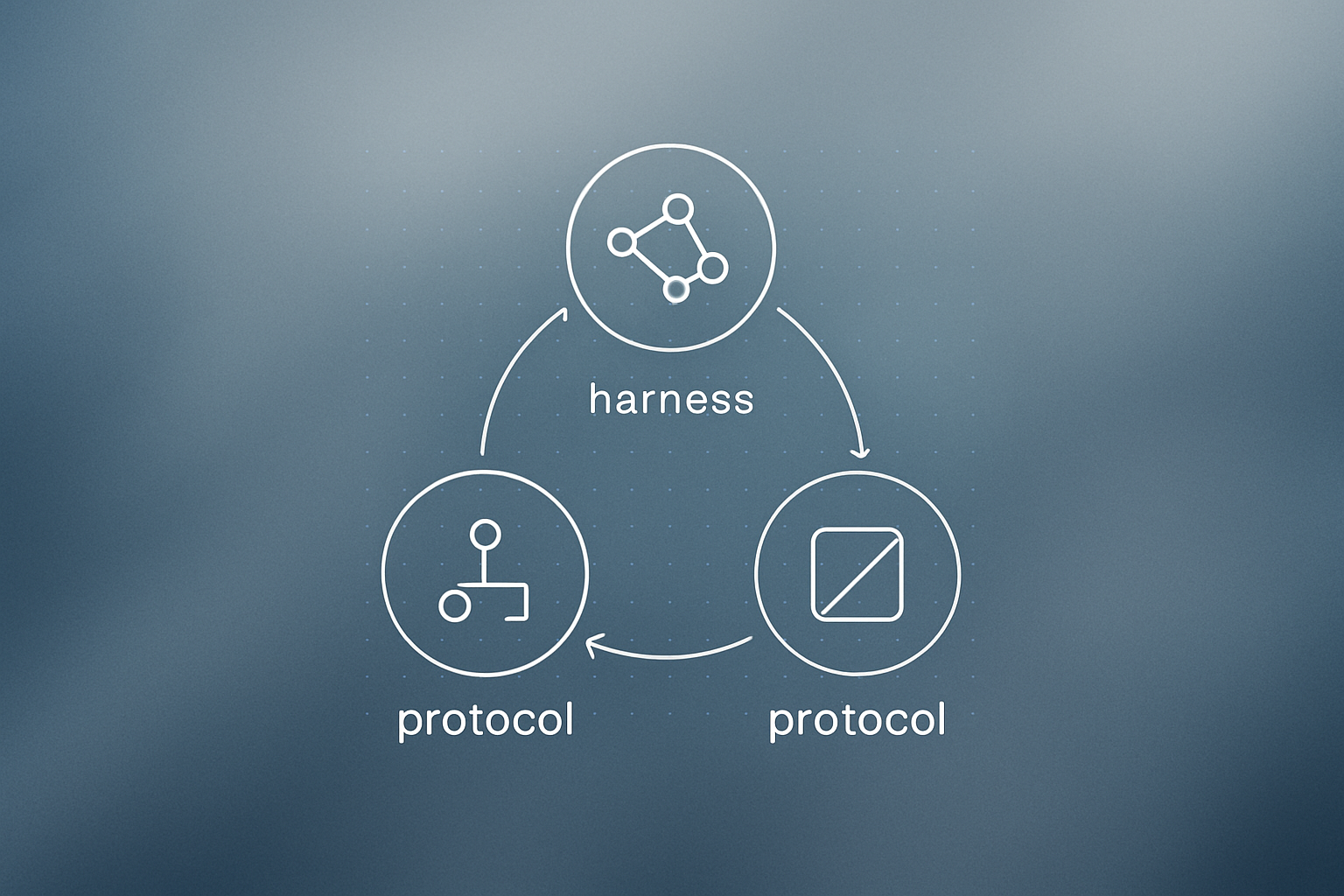
Agent harness, agent framework, and MCP get used as synonyms in almost every architecture discussion. They are not synonyms. Each sits at a different layer, owns a different slice of agent behavior, and overlaps with the others only at the edges. This breakdown maps five core responsibilities: execution loop, state, tool transport, permissions, and recovery. Knowing which layer owns each one prevents the most common agent design mistakes.
What happened
| Layer | Key fact |
|---|---|
| Agent harness | Ships a fixed loop, sandbox, and permission model as one unit (Claude Code, OpenAI Codex platform) |
| Agent framework | Provides configurable primitives: LangGraph, OpenAI Agents SDK, Microsoft Agent Framework 1.0 GA (April 2026) |
| MCP | Stateless JSON-RPC 2.0 wire protocol; session handshake retired in the July 28 2026 spec update |
| Governance | Linux Foundation’s Agentic AI Foundation governs MCP since December 2025 |
The three terms describe three genuinely different things, and mixing them up tends to produce agents with no clear owner for state management, confused permission boundaries, or recovery logic that nobody actually implemented.
The three layers, defined plainly
Agent harness
A harness wraps a model and turns it into a working agent. OpenAI’s Codex platform post from August 19 2026 defines it directly: the harness manages conversation state, streams execution, runs tools, enforces sandbox and approval policies, and carries work across turns. Anthropic’s Claude Code documentation uses the same term. The Claude Agent SDK exposes “the same tools, agent loop, and context management that power Claude Code.”
The harness is opinionated by design. You get a loop, a permission model, a sandbox, and a context strategy as one unit. The loop is not yours to rewrite. The Claude Agent SDK documents its loop as five steps: receive prompt, evaluate and respond, execute tools, repeat, return result. Each full cycle is one turn. The loop ends when the model produces a response with no tool calls.
Agent framework
A framework is a library of primitives. It covers model clients, tool abstractions, graph orchestration, memory interfaces, and observability hooks. You assemble those parts and configure the loop yourself. Notable examples include LangGraph (where the loop is whatever graph you draw), the OpenAI Agents SDK (loop terminates on final output, raises MaxTurnsExceeded when the limit is hit), and Microsoft Agent Framework, which reached 1.0 GA in April 2026.
The framework gives you the skeleton. You decide the policy: termination conditions, handoff logic, turn caps, guardrail behavior.
MCP
The Model Context Protocol is a wire protocol, not a runtime. It standardizes how an LLM application discovers and calls capabilities exposed by servers: tools, resources, and prompts. The transport is JSON-RPC 2.0 over stdio or Streamable HTTP.
Crucially, the July 28 2026 specification made the protocol core stateless. The initialize/initialized handshake and the Mcp-Session-Id header were retired. Every request now travels alone, carrying its protocol version and client capabilities in _meta. MCP has no loop and, since that update, no session layer either. If a server needs state across calls, it mints a handle from a tool and the model passes it back.
Who owns what: the full ownership map
| Responsibility | Agent harness | Agent framework | MCP |
|---|---|---|---|
| Execution loop | Owns: fixed, product-grade loop | Owns skeleton: you configure termination and turn caps | None: request/response only |
| Agent state and memory | Owns: sessions, resume, fork, file checkpointing | Exposes: checkpointers, session stores, thread IDs | None at protocol level (since July 28 2026) |
| Tool transport | Consumes: built-in tools plus MCP client | Consumes: function tools plus MCP client | Owns: JSON-RPC over stdio or Streamable HTTP |
| Permissions and approvals | Owns: permission modes, hooks, sandbox | Exposes: guardrails, interrupts, middleware | Delegates to host: cannot enforce |
| Recovery | Owns: session resume, checkpoint rewind, compaction | Exposes: durable execution, replay, retries | Partial: tasks extension for long-running calls |
| Isolation and sandboxing | Owns: OS sandbox, worktrees, containers | Optional: hosted sandboxes or micro-VMs | None |
| Multi-agent orchestration | Owns patterns: subagents, dynamic workflows | Owns primitives: graphs, handoffs, fan-out | None: A2A covers agent-to-agent |
Why it matters
Most agent reliability failures trace back to ownership gaps in this table. If you build on a framework and assume it handles state recovery the way a harness does, you will lose work on crashes unless you explicitly attach a checkpointer and pass a thread ID. LangGraph offers three durability modes: “exit” (persists only when the graph exits), “async” (writes while the next step runs), and “sync” (writes before each step). Choose wrong and a mid-run crash silently drops state.
Permissions are the other common gap. MCP cannot enforce access policies. It delegates to the host. If your harness or framework does not define an approval policy, no layer does. The Claude Agent SDK and the Codex harness both own this explicitly. A bare framework implementation does not.
For teams exploring AI integration for production workflows, the choice between harness and framework is effectively a build-vs-buy decision on loop reliability, sandboxing, and recovery. A harness trades flexibility for correctness guarantees. A framework trades guarantees for control.
Our take
The conflation of these three terms is not just an academic problem. We see it cause real scoping failures: teams building with LangGraph who expect session resume without configuring a checkpointer, or teams adopting MCP and assuming the protocol handles permissions when it explicitly does not.
The ownership table above is the most useful mental model we have seen for cutting through the noise. Build from it before you write a line of agent code. If you are evaluating whether to use a harness (lower flexibility, higher correctness) versus a framework (higher flexibility, you own reliability), that decision should happen at the architecture stage, not after you have shipped something fragile into production.
The July 28 2026 MCP statelessness change is also worth watching closely. Server developers who relied on session headers for state continuity need to migrate to handle-based state. The protocol is moving toward simpler, more composable primitives, which is sensible, but it shifts more responsibility onto host implementations. We have been covering shifts in how AI agents are architected and resourced across several stories, and this is consistent with a broader trend toward leaner protocols with heavier host-side logic.
What to do about it
- Map your agent’s five responsibilities (loop, state, tools, permissions, recovery) against the ownership table before choosing a stack.
- If you need guaranteed state recovery and sandboxing out of the box, evaluate a harness first (Claude Agent SDK, OpenAI Codex platform).
- If you need custom loop logic, multi-graph orchestration, or polyglot tool composition, pick a framework and explicitly wire each durability and permission layer yourself.
- Treat MCP as a tool transport contract only. Do not rely on it for state or permissions.
- If your MCP servers used session headers for state continuity, migrate to handle-based state patterns as described in the July 28 2026 specification.
The simplest rule: whichever layer you choose, make sure someone in that stack explicitly owns each row of the table above.
Frequently asked questions
What is the difference between an agent harness and an agent framework?
A harness ships a fixed, product-grade execution loop, sandboxing, and permission model as one unit. You cannot rewrite the loop. A framework gives you configurable primitives: model clients, tool abstractions, graph orchestration. You build and configure the loop yourself. Examples of harnesses include Claude Code and OpenAI Codex. Examples of frameworks include LangGraph and the OpenAI Agents SDK.
Does MCP handle agent state or session management?
No. The July 28 2026 MCP specification retired the initialize/initialized handshake and the Mcp-Session-Id header, making the protocol core stateless. If a server needs state across calls, it must mint a handle from a tool and pass it back via the model. MCP owns no agent state at the protocol level.
Who governs the Model Context Protocol?
The Linux Foundation's Agentic AI Foundation has governed MCP since December 2025, alongside related projects including goose, AGENTS.md, and A2A.
Which agent framework reached 1.0 GA and when?
Microsoft Agent Framework reached 1.0 GA in April 2026.