AI Agents Use Far More Energy Than Chatbots. Here’s the Real Cost.
AI agents run far more compute cycles than simple chatbot queries. Here's what that means for energy use, data center buildout, and your AI tool costs.
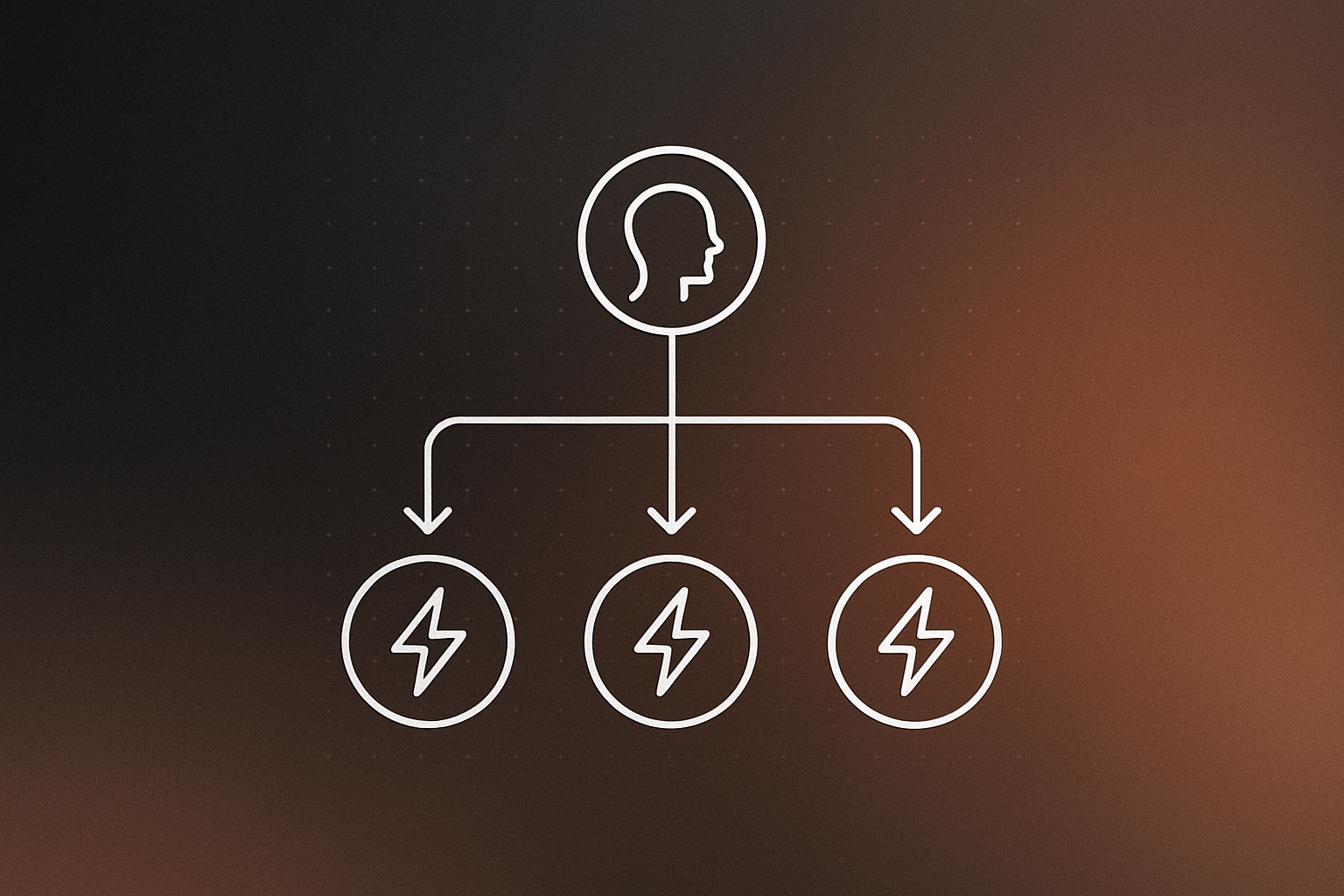
AI agents, which are LLM-based systems that make autonomous decisions and re-prompt themselves dozens of times to complete complex tasks, consume vastly more energy than a single chatbot query. That gap is the real reason tech companies are spending billions on data centers. From OpenAI's 10,000-agent math experiment to Meta's new Muse personal agent, the shift from simple Q&A to autonomous AI work is creating a largely undisclosed and rapidly growing energy footprint that industry CEOs have barely begun to account for publicly.
What happened
| Fact | Detail |
|---|---|
| OpenAI agent swarm | More than 10,000 agents, 2.7 million messages, to solve one math problem |
| Estimated compute cost | Probably tens of millions of dollars, per Wired’s Maxwell Zeff |
| Hausfather’s daily Claude use | Energy equivalent of running more than two refrigerators continuously |
| Altman’s comparison | 38,000 ChatGPT queries equals the water to grow one almond (disputed) |
| Meta Muse | Personal AI agent, dedicated cloud computer per user, offline operation, AI glasses integration planned for later this year |
The question “what are all these data centers actually for?” has a concrete answer now. It is not recipe searches or travel planning. It is agents. An AI agent, roughly defined, is an LLM-based system that breaks a user’s goal into hundreds of smaller steps, re-prompts itself autonomously, and keeps running until the task is done. That looping process is exponentially more compute-intensive than a one-shot query.
Maxwell Zeff, who covers AI for Wired, offered a practical example: ask an agent to build a website and it might run for hours, re-prompting itself dozens of times to produce pages, menus, and backend datasets. That is not a fraction-of-an-almond problem. That is a sustained workload running on GPU clusters at scale.
Why does this matter for energy and cost?
Boris Gamazaychikov, co-founder and CEO of Sustainable AI, a research and advisory group, put it plainly: traditional tech growth is capped by user behavior. There are only so many people streaming video or driving cars. AI agents break that ceiling because they operate in the background, independent of direct human action. AI company leaders openly talk about companies staffed by one human employee supported by hundreds or thousands of background agents. Every one of those agents burns compute continuously.
The energy numbers are hard to pin down because companies don’t publish them. Sam Altman’s almond comparison, which frames resource use around individual queries, is increasingly misleading as agents become the default interaction model. Hausfather noted that his agent-heavy AI use, while not “world-ending” in isolation, is still a net new source of emissions at a time when global temperature targets are slipping. His estimate was based on sources Gamazaychikov called somewhat outdated, which itself shows how little academic work has been done and how little the companies disclose.
Gamazaychikov’s group plans to release more precise research on the environmental footprint of agents running on closed models. That data does not exist in the public domain yet, and the gap is significant.
Meta’s Muse raises the stakes further
Last week Meta announced Muse, described in a company press release as “built to work for billions of people worldwide.” Each user gets a dedicated cloud computer that keeps running even when the user is not active. Meta plans to connect Muse to its AI glasses later this year. If even a fraction of Meta’s user base activates this, the aggregate compute load is enormous, and that load runs continuously rather than only when someone types a question.
This is the scenario Gamazaychikov’s framing captures: AI energy use is decoupling from active user sessions. A billion idle Muse instances are still compute instances.
Our take
The almond comparison deserves to be retired. It was a rhetorical move designed to make per-query costs sound trivial, and it worked for a moment when chatbots were the product. Agents are a different category entirely. Businesses evaluating AI integration for real workflows should be asking vendors for compute cost estimates per task, not per query, because the billing model and the environmental footprint are both going to scale with task complexity.
Transparency here is close to zero. OpenAI, Anthropic, Meta, and Google do not publish per-task energy or cost data for agentic workloads. That makes it nearly impossible for a business to forecast what running an internal agent fleet will actually cost in dollars or carbon. Until disclosure improves, treat vendor estimates with healthy skepticism. If you are currently running or piloting agent-based tools, track your API spend closely. It will be the most honest signal you have of actual resource consumption.
We have covered related questions about AI compute and policy pressure in our piece on Trump’s AI policy dilemma around growth versus safety. The energy question is quickly becoming the same kind of political flashpoint. Watch for regulation targeting data center power draw, it is already moving at the state level in the US.
What to do about it
- Audit your current AI tool spend by task type. Simple queries and full agent runs are priced very differently across providers.
- Ask any AI vendor you are evaluating to give you per-task compute estimates, not per-query stats, before signing a contract.
- Set spending caps on agent API calls now. Without them, an agent loop that fails gracefully in testing can run for hours in production.
- Watch for Sustainable AI’s upcoming research on closed-model agent footprints. It will be the first credible public benchmark on this topic.
The practical takeaway: agent costs scale with task complexity in ways that simple chatbot pricing never did, so build that assumption into your AI budgets before it shows up as a surprise invoice.
Frequently asked questions
Why do AI agents use more energy than chatbots?
AI agents re-prompt themselves dozens or hundreds of times to complete a single task, running for hours in some cases. A simple chatbot query is a one-shot interaction. The looping, autonomous nature of agents means they consume far more compute, and therefore far more energy, per user request.
How much energy does using an AI agent actually consume?
Climate scientist Zeke Hausfather estimated that his heavy daily use of Claude agents consumes more energy than running two refrigerators continuously. His calculation was based on sources that a Sustainable AI researcher described as somewhat outdated, so actual figures may differ. No AI company publishes precise per-task energy data.
What is Meta Muse?
Muse is Meta's personal AI agent, announced recently and described as built for billions of users worldwide. Each user gets a dedicated cloud computer that keeps running even when they are not online. Meta plans to integrate Muse with its AI glasses later in 2025.
Is Sam Altman's claim about almonds and ChatGPT accurate?
Altman claimed that the water used to grow one almond equals the water needed for 38,000 ChatGPT queries. That calculation has been disputed, and critics note it applies to simple one-shot queries, not to AI agents, which are far more resource-intensive.