Stanford Study: Entry-Level Workers in AI-Exposed Jobs Are 19% Behind Peers
A Stanford study finds workers aged 22-25 in AI-exposed occupations now have 19% lower employment than peers in less-affected fields, up from 13% last year.
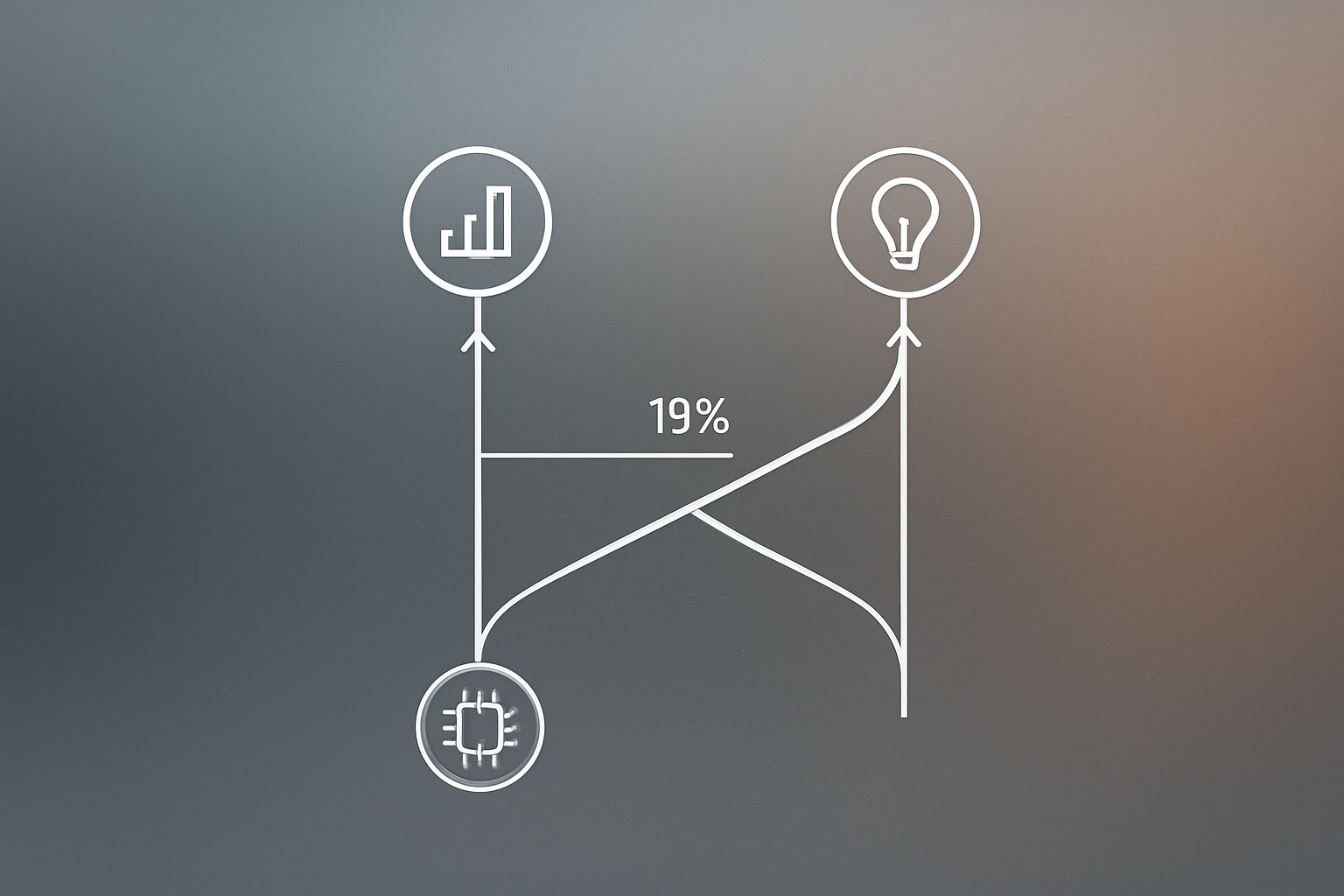
A Stanford University economics paper updated in August 2026 finds that young workers in occupations most exposed to AI disruption are falling significantly behind their peers. Employees aged 22 to 25 in the most AI-exposed jobs now show employment levels 19 percent below those in less-affected fields. That same gap was 13 percent when the researchers measured it just a year ago. Older workers, by contrast, appear largely unaffected so far, suggesting AI is hitting the bottom of the career ladder first.
What happened
| Detail | Fact |
|---|---|
| Paper title | “Canaries in the Coal Mine? Six Facts about the Recent Employment Effects of Artificial Intelligence” |
| Publisher | Stanford University economists |
| Edition | August 2026 update of a paper first published the prior year |
| Age group studied | Workers aged 22 to 25 |
| Employment gap (current) | 19% below peers in less AI-exposed occupations |
| Employment gap (prior year) | 13% below peers in less AI-exposed occupations |
| Older workers | Largely unaffected so far |
Stanford economists first published “Canaries in the Coal Mine” to track whether early signals of AI-related job displacement were showing up in employment data before they became impossible to ignore. The August 2026 update adds fresh data and refined statistics to that original work.
The core finding is straightforward: young workers in “AI-exposed” occupations (roles where AI tools can perform a meaningful share of the tasks) are getting fewer jobs relative to peers in less-exposed fields. The gap widened from 13 percent to 19 percent in a single year. The researchers describe the trend as both persisting and expanding.
Why does this gap only show up for younger workers?
The paper does not spell out a single cause, but the pattern fits a recognisable dynamic. Entry-level roles are often justified by the volume of routine, well-defined tasks they handle. Those are exactly the tasks AI handles cheapest and fastest. Senior workers hold relationships, institutional knowledge, and judgment that is harder to automate. They also have more leverage to adapt their roles around AI tools rather than being replaced by them.
In short, the bottom of the career ladder is where AI displacement shows up first, because that is where human labor and AI capability overlap most directly. Older workers, who are largely unaffected according to the Stanford data, may face their own disruption later as AI capability expands, but that is not yet visible in this research.
Why it matters
A 6-percentage-point widening in one year is a fast-moving signal. If the trend continues at anything near that pace, the employment picture for new graduates in AI-exposed fields could look very different by 2028 than it did in 2024.
For businesses, there are two sides to this. On one hand, teams are getting leaner at the junior level, which compresses short-term headcount costs. On the other hand, a shrinking pipeline of entry-level workers means fewer people developing the domain experience that eventually becomes senior expertise. Companies that hollowed out their junior tiers in the short term may find a skills gap waiting for them in five years.
For anyone building or buying AI integration services, this data is a reminder that efficiency gains are not abstract. They land somewhere specific, usually on the people doing repeatable, task-based work. That has implications for how automation projects are scoped, communicated, and managed inside organisations. We covered a related tension in our piece on why broken AI promises hurt organisations more than broken AI products.
Our take
The Stanford paper is one of the more grounded pieces of AI employment research out there because it tracks actual hiring outcomes rather than surveying people’s fears about future disruption. A 19 percent employment gap, widening by 6 points in a year, is not a projection. It is a measurement.
That said, “AI-exposed occupation” is doing a lot of work in this study. The source does not detail exactly which roles count, which makes it hard to know whether the effect is concentrated in, say, coding and content writing or spread across a wider set of fields. Readers should treat the headline number as a directional signal, not a precise forecast for any specific job category.
From where we sit, the practical implication is this: if your business uses junior staff to handle high-volume, well-defined tasks, the economics of that model are shifting fast. That is not a reason to panic, but it is a reason to map your workflows and understand where human effort is still genuinely adding value and where it is not. Our workflow automation practice works through exactly that kind of audit with clients.
What to do about it
- Map the tasks your entry-level staff actually do and flag which ones AI tools can already perform reliably.
- Identify what those staff do that AI cannot replicate well: client relationships, contextual judgment, cross-team coordination.
- Restructure junior roles around those high-value tasks before attrition makes the decision for you.
- Build a skills development path so that people entering your organisation accumulate judgment, not just task completion.
The canary is singing. The question is whether your organisation is listening before the air runs out.
Frequently asked questions
Which workers are most affected by AI job losses according to Stanford?
According to the August 2026 Stanford study, workers aged 22 to 25 in the most AI-exposed occupations are most affected. Their employment levels are now 19% below peers in fields less exposed to AI disruption.
How fast is the AI employment gap widening?
The gap widened from 13% to 19% in a single year, based on comparing the original Stanford paper to its August 2026 update. The researchers describe the trend as persisting and expanding.
Are older workers losing jobs to AI too?
Not according to this Stanford research. The study finds that older workers appear largely unaffected so far, with the displacement concentrated in workers aged 22 to 25.
What does 'AI-exposed occupation' mean in the Stanford study?
It refers to roles where AI tools can perform a meaningful share of the tasks involved. The source does not list specific job titles, so the exact occupations included are not publicly detailed in the summary available.