Rippling’s AI Bill Hit 40% of R&D Payroll. So It Built a Fix.
Rippling's AI token spend hit 40% of R&D payroll before it built AI Spend Console. Here's what the tool does, what it costs, and what the numbers revealed.
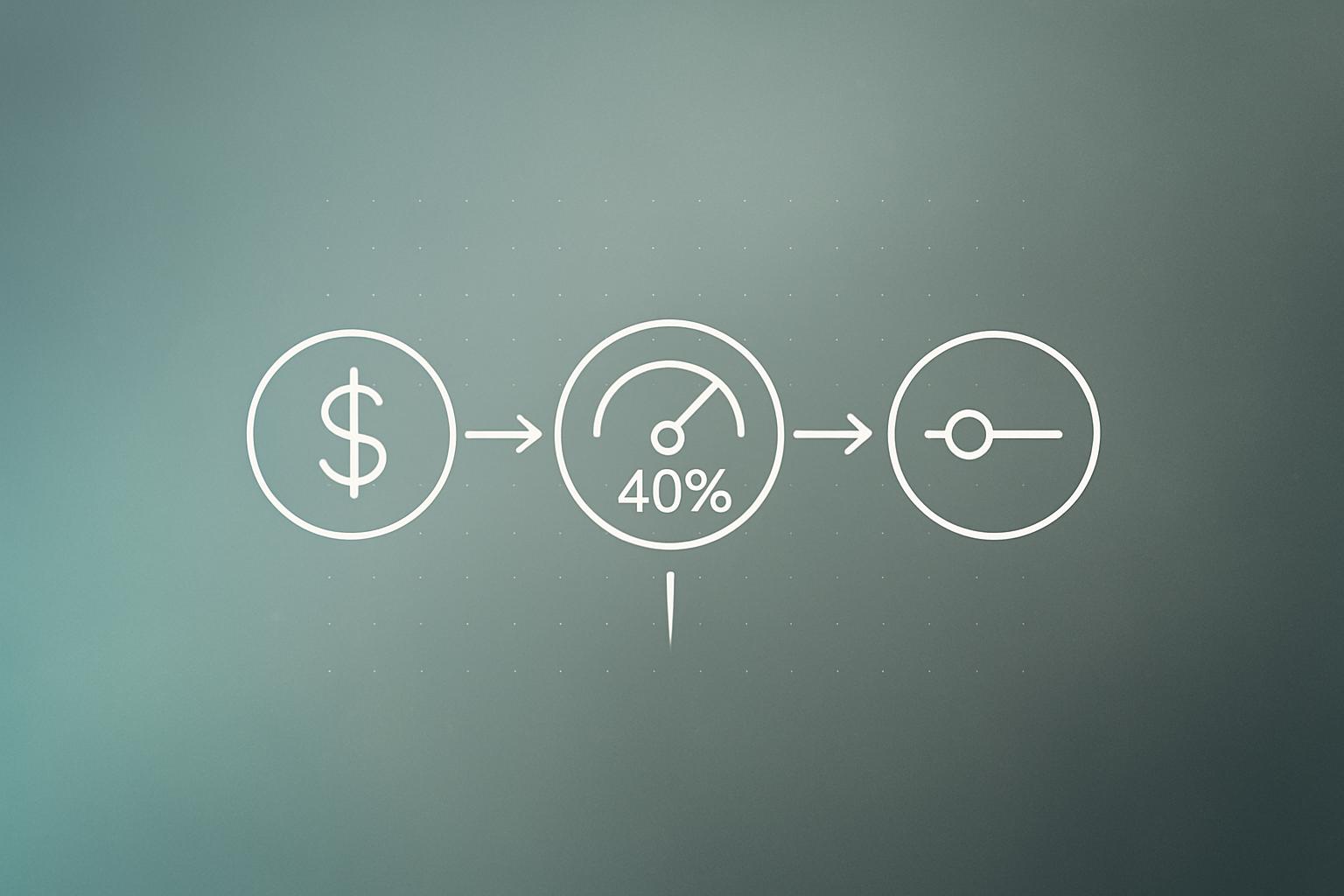
HR software company Rippling went all-in on AI tool access for employees early in 2026, only to discover in March that token costs were on track to equal 40% of its entire R&D payroll, growing at 80% per month. Rather than shut access down, it built AI Spend Console, a product that maps spending per employee, team, and role against real productivity signals like pull requests and code reviews, and routes prompts to cheaper models automatically. The company cut its token cost-to-payroll ratio from 40% to 15% without reducing usage volume.
What happened
| Data point | Detail |
|---|---|
| AI spend as % of R&D payroll (peak) | On track for 40% |
| Month-over-month spend growth | 80% |
| Projected spend (next year, if unchecked) | ~90% of R&D payroll |
| Top spender | One engineer at $50,000/month |
| Employee concentration | 10-15% of employees drove 60% of spend |
| Peak token volume (April) | 605 billion tokens |
| Token volume in July | 600 billion tokens |
| July cost vs. April cost | 37% (same volume, 63% cheaper) |
| Spend after controls | ~15% of R&D payroll |
Rippling CFO Adam Swiecicki brought the numbers to an executive meeting in March. The R&D team, which houses engineering, was burning AI tokens at a rate that would have equalled nearly all of what Rippling pays those engineers within a year. Chief Product Officer Matt MacInnis told TechCrunch the reaction was simple: “We were incredulous.”
The culprit was not rogue usage exactly. Employees defaulted to the newest and most expensive frontier models for every task, including ones that did not need them. According to MacInnis, inference providers like Anthropic and OpenAI “have absolutely no incentive to help you control your spend,” and their usage dashboards reflect that. Rippling started by negotiating spending caps directly with each tool it used: Cursor, OpenAI, and Anthropic.
What AI Spend Console actually does
The core of the product is a dashboard (Rippling pointedly calls it a dashboard rather than a leaderboard) that scores employees on prompts per day combined with measurable work output such as lines of code and pull requests, cross-referenced with their token spend. The goal is to surface who is getting genuine leverage from AI and who is generating expensive noise.
Rippling gives a blunt example in its blog post: the tool can identify “engineers with high AI spend whose peers frequently ask them to redo work in code reviews.” That is the AI slop signal they wanted to catch.
Underneath the dashboard sits a proprietary AI gateway that routes each prompt to the most cost-effective model for the task. Rippling CEO Parker Conrad noted last month that internal benchmarks found Z.ai’s GLM 5.2 to be “85% cheaper but nearly identical in performance” to frontier models for many coding tasks. Routing to models like that, rather than always defaulting to the latest release, is what drove July’s cost down to 37% of April’s, even though token volume was nearly identical.
Companies that already run a third-party AI gateway can still use the Spend Console dashboards, but spend governance features require Rippling’s own gateway.
Why it matters
This is a concrete early-2026 case study in what happens when enterprises give engineers broad AI tool access without routing or cost controls. The math compounds fast. At 80% monthly growth, a budget problem becomes a budget crisis within two quarters.
The broader lesson Rippling draws is that multi-model routing is now table stakes. Paying frontier prices for grammar fixes and boilerplate code is the equivalent of, in MacInnis’s words, “letting the sales team do grammar updates using Fable.” The spend mix matters as much as the total spend.
There is also a governance question that goes beyond engineering. Rippling is still working out how to extend AI access to customer-facing and general and administrative teams, where productivity is harder to tie directly to token consumption. MacInnis is direct: “If we can’t do that, all bets are off on any of this stuff being available to the broader employee base.” For businesses thinking about AI integration across departments, that is the real bottleneck, not the cost of the models themselves.
The trend is also visible across the industry. Databricks has separately been promoting Z.ai’s GLM 5.2 for coding tasks, and the shift toward cheaper, open-weight models of varying origins is accelerating as enterprises compare benchmark results against real internal workloads rather than published leaderboard scores.
Our take
Rippling’s numbers are unusually specific, and that specificity is the value here. Most companies burning through AI budgets right now have no idea which employees or workflows are driving the spend, because the providers have no incentive to tell them. Rippling had to build its own tooling to find out.
The 40% to 15% reduction without cutting usage volume is a real result, and the mechanism is straightforward: route cheaper models to simpler tasks. You do not need a custom product to start doing this. A basic AI gateway with model routing, combined with per-team spend limits negotiated directly with providers, gets you most of the way there before you need a dashboard.
The harder problem Rippling is still wrestling with, tying token spend to productivity in non-engineering roles, is something most businesses will hit well before they need a spend console. That is worth mapping before you expand AI access beyond your technical team. If you are thinking about how to structure that, our team is happy to talk through it on a quick call.
As for the product itself: included in Rippling’s existing HR subscription with usage-based add-on costs is a reasonable model. But the underlying insight, that AI model routing and per-employee accountability matter more than blanket access, is something any business running AI tools at scale should be acting on now. For context on how spend and output tracking plays out in real client projects, see our case studies.
What to do about it
- Pull your current AI tool invoices and break them down by team or cost center. Most providers give at least some usage data even if the granularity is poor.
- Negotiate spending caps per tool with each provider before month-end. Cursor, OpenAI, and Anthropic all support this.
- Identify which tasks your team uses AI for most, then check whether a cheaper model handles them at acceptable quality. GLM 5.2 and similar open-weight options are worth benchmarking against your actual workloads.
- Set up an AI gateway (Cloudflare AI Gateway, LiteLLM, or similar) to route prompts by task type. This alone can cut costs significantly without restricting access.
- Define what productivity looks like per role before giving non-engineering teams broader AI access. If you cannot measure output, you cannot justify the spend.
Start with the spend audit. Everything else depends on knowing the actual number.
Frequently asked questions
What is Rippling AI Spend Console?
AI Spend Console is a product from HR software company Rippling that tracks AI token spending per employee, team, and role, and maps that spend against productivity signals like pull requests and code reviews. It includes an AI gateway that routes prompts to the most cost-effective model for each task. It is included for existing Rippling HR subscribers with additional usage-based costs.
How much was Rippling spending on AI tokens?
In early 2026, Rippling's token spend was on track to equal 40% of its entire R&D payroll and was growing at 80% month-over-month. One engineer alone was spending $50,000 per month. After introducing model routing and spend controls, the ratio dropped to about 15% of R&D payroll.
What is tokenmaxxing?
Tokenmaxxing refers to the practice of giving employees broad, uncapped access to AI tools and models without restrictions, on the assumption that more AI usage equals more productivity. Rippling used the term to describe its approach at the start of 2026, before discovering it led to runaway costs without proportional output gains.
What is GLM 5.2 and why are companies using it?
GLM 5.2 is a model from Z.ai, a Chinese AI company. Rippling CEO Parker Conrad stated that internal benchmarks found it to be 85% cheaper than frontier models with nearly identical performance for many tasks. Databricks has also promoted it, and it has become a popular choice for coding tasks among enterprises looking to cut AI inference costs.