LingBot-World-Infinity: Ant Group’s Causal World Model Explained
Ant Group's Robbyant unit releases LingBot-World-Infinity, a 14B causal video world model with a two-agent harness, anti-drift training, and 60 fps output.
Robbyant, the embodied-intelligence division of Ant Group, has released LingBot-World-Infinity (also called LingBot-World 2.0), a causal video generation model that acts as an interactive world simulator. The 14B-parameter model generates video frame by frame, conditioned on user actions, and claims to solve two recurring problems: visual quality degradation over long sequences and the latency that makes interactive use feel sluggish. A lightweight 1.3B variant is also described, though only one checkpoint is publicly downloadable right now.
What happened
| Detail | Fact |
|---|---|
| Publisher | Robbyant (Ant Group’s embodied-intelligence unit) |
| Model name | LingBot-World-Infinity / LingBot-World 2.0 |
| Primary model size | 14B parameters |
| Lightweight variant | 1.3B parameters (single GPU deployable) |
| Real-time output | 720p at 60 fps (distilled variant, via TensorRT) |
| Reference inference setup | 8 GPUs, 480×832 resolution |
| Codebase foundation | Wan2.2 |
| Downloadable checkpoint today | lingbot-world-v2-14b-causal-fast only |
LingBot-World-Infinity is an interactive world model, meaning it generates video one frame at a time based on a stream of user inputs. The model is formally trained as a causal factorization: each visual state depends only on past frames and the current action. Actions combine a camera pose (encoded with Plücker embeddings, injected via adaptive layer normalization) and a text prompt (fed through cross-attention in chunks).
The claimed improvements over the previous version include: an unbounded interaction horizon without quality decay, the 60 fps real-time variant, a broader action space covering attacking, archery, spell-casting, and shooting, and a two-agent control harness.
Why does long-horizon drift happen, and how does MoBA fix it?
The core technical problem with autoregressive video models is drift. Standard training uses a “teacher forcing” mask where each noisy frame attends to itself and its clean context. According to the Robbyant research team, as context grows the model learns to lean on that context rather than predict future frames accurately, leading to overfitting and visual degradation.
Their fix is the Mixture of Bidirectional and Autoregressive (MoBA) Attention Mask. MoBA adds a bidirectional full-attention block on top of the teacher forcing mask. That block acts as a regularizer and also allows the model to handle variable-length generation. The cross-attention mask mirrors this split: the autoregressive part attends to prompts in a lower-triangular pattern (preventing future semantics from leaking backward), while the bidirectional part attends to a single global prompt.
Post-training distillation compresses the multi-step model into a faster few-step version using two techniques:
- Consistency distillation: Latents on the same probability-flow ODE trajectory must map to identical predictions.
- Distribution matching distillation (DMD): Applied over long self-rollout trajectories, not just teacher-forced states. This means the student model is optimized on the state distribution its own predictions create, which is the stated mechanism behind anti-drift behavior.
The agentic harness: two agents, not one
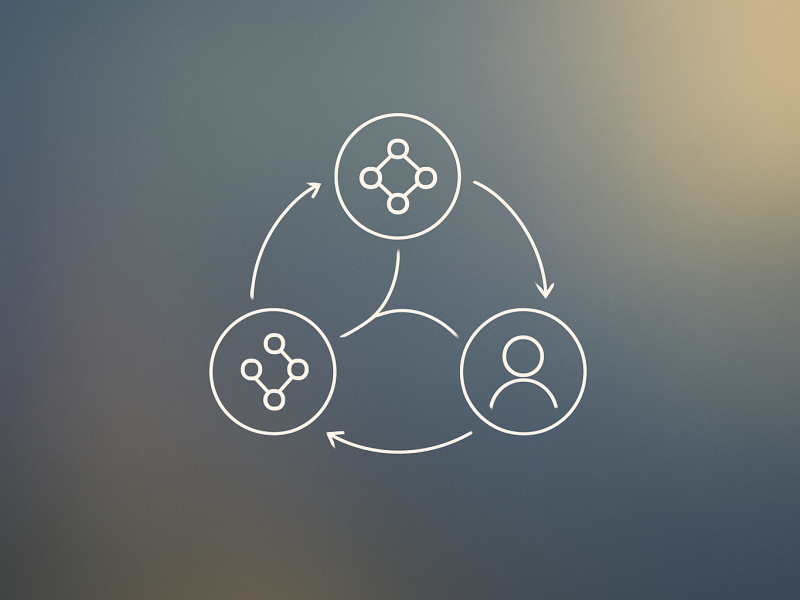
The more interesting feature for practical applications is the Director-Pilot Co-Simulation Framework. Rather than giving users raw control over a video generator, the system pairs two agents:
- Director: A Vision-Language Model (VLM) that handles high-level semantic rules and causal reasoning.
- Pilot: A Diffusion Transformer that simulates low-level physical dynamics and renders transitions.
The harness offers two interaction modes. Mode A (Direct Semantic Interaction) has the VLM read the current frame and generate event cards with no object masks required. Mode B (Tracking-Assisted Object Interaction) uses a SAM-based (Segment Anything Model) loop to track objects across chunks so users can select a specific object and trigger actions on it.
Users can also intervene at the world level: global state changes can shift time of day or weather, while local entity injection can spawn creatures at VLM-chosen entry points. The control scheme follows game conventions: WASD for movement, IJKL for view, Space for jump, P for wing glide, U and O for VLM-proposed character actions, F and G for environmental events, and numeric keys for user-registered event slots.
What actually ships today
Expectations need calibrating. The codebase is built on Wan2.2, and only the lingbot-world-v2-14b-causal-fast checkpoint is downloadable right now. The causal-pretrained 14B, the bidirectional 14B, and both 1.3B variants are all marked TODO in the repository.
The reference inference command requires eight GPUs at 480×832 resolution, generating 361 frames. The 60 fps figure refers to the deployed stream, not the base model output. That stream passes a spatio-temporal refiner that upsamples decoded frames and synthesizes intermediate frames. Both stages are compiled into TensorRT engines. A Diffusers-compatible checkpoint also exists for users who prefer that pipeline.
For teams exploring what open-source world models can do, this is worth watching. For production use, the missing checkpoints and the eight-GPU reference setup are real barriers today. This is a research release with commercial ambition, not a drop-in tool yet. If you’re evaluating AI integration options for your own products, Lumien’s AI integration service covers exactly this kind of feasibility assessment.
Our take
The MoBA attention mechanism and the DMD-over-rollouts training approach are the genuinely novel pieces here. Most papers address drift by limiting context length or adding memory modules. Optimizing the student on its own induced state distribution is a cleaner framing of the problem, and if it holds up under independent replication, it matters for any long-horizon video or simulation task.
The agentic harness is compelling on paper. A VLM director sitting above a diffusion pilot is a reasonable architecture for interactive simulation, and the two interaction modes (with and without object tracking) show practical thinking. But the research paper’s examples are door-opening and ball-rotating rollouts, which are tightly controlled demos. Real-world robustness at scale is an open question.
The availability gap is the honest caveat. One checkpoint, eight GPUs, 480p. The 60 fps claim is real but requires TensorRT compilation and a separate refiner stage that is not fully documented in the public release. Businesses watching the embodied AI and interactive simulation space should track the TODO checkpoints rather than treat this as immediately deployable. For context on how open-source AI model releases tend to evolve from research to enterprise tooling, see our coverage of why big companies are moving from renting to owning their AI models.
What to do about it
- Star the
robbyant/lingbot-world-v2GitHub repository to track when the missing checkpoints (1.3B, bidirectional 14B) go live. - If you have access to eight GPUs, clone the repo and run the provided
generate.pyon the causal-fast checkpoint to establish a baseline before the other variants drop. - Read the MoBA attention mask section of the paper alongside the DMD training description. Those two pieces are the core contribution worth evaluating for your own video or simulation pipelines.
- Wait for third-party replication of the 60 fps and anti-drift claims before building production dependencies on this model.
Follow the checkpoint releases closely: the 1.3B single-GPU variant, if it delivers even half the claimed quality, is the version most teams can actually run.
Frequently asked questions
How many GPUs does LingBot-World-Infinity require to run?
The reference inference command in the public release uses eight GPUs at 480x832 resolution to generate 361 frames. A 1.3B variant described in the paper is said to be deployable on a single GPU, but that checkpoint is not yet available to download.
What is a causal world model in AI?
A causal world model generates video frame by frame where each state depends only on past frames and the current user input, not on future information. This mirrors how real-world sequences unfold and makes the model usable for interactive simulation.
Can LingBot-World-Infinity really output 60 fps at 720p?
According to Robbyant, the distilled real-time variant can drive a 720p stream at 60 fps, but this requires a spatio-temporal refiner that upsamples decoded frames and synthesizes intermediate frames. Both stages are compiled into TensorRT engines, so it is not the raw model output.
What checkpoints are available for LingBot-World-Infinity right now?
As of the release, only the lingbot-world-v2-14b-causal-fast checkpoint can be downloaded. The causal-pretrained 14B, the bidirectional 14B, and both 1.3B variants are marked TODO in the repository.