WeatherNext 3: Google DeepMind’s 5 km Forecasts Updated Every Hour
Google DeepMind's WeatherNext 3 delivers 5 km global weather forecasts refreshed hourly, trained on raw station data. Available via BigQuery now, closed weights.
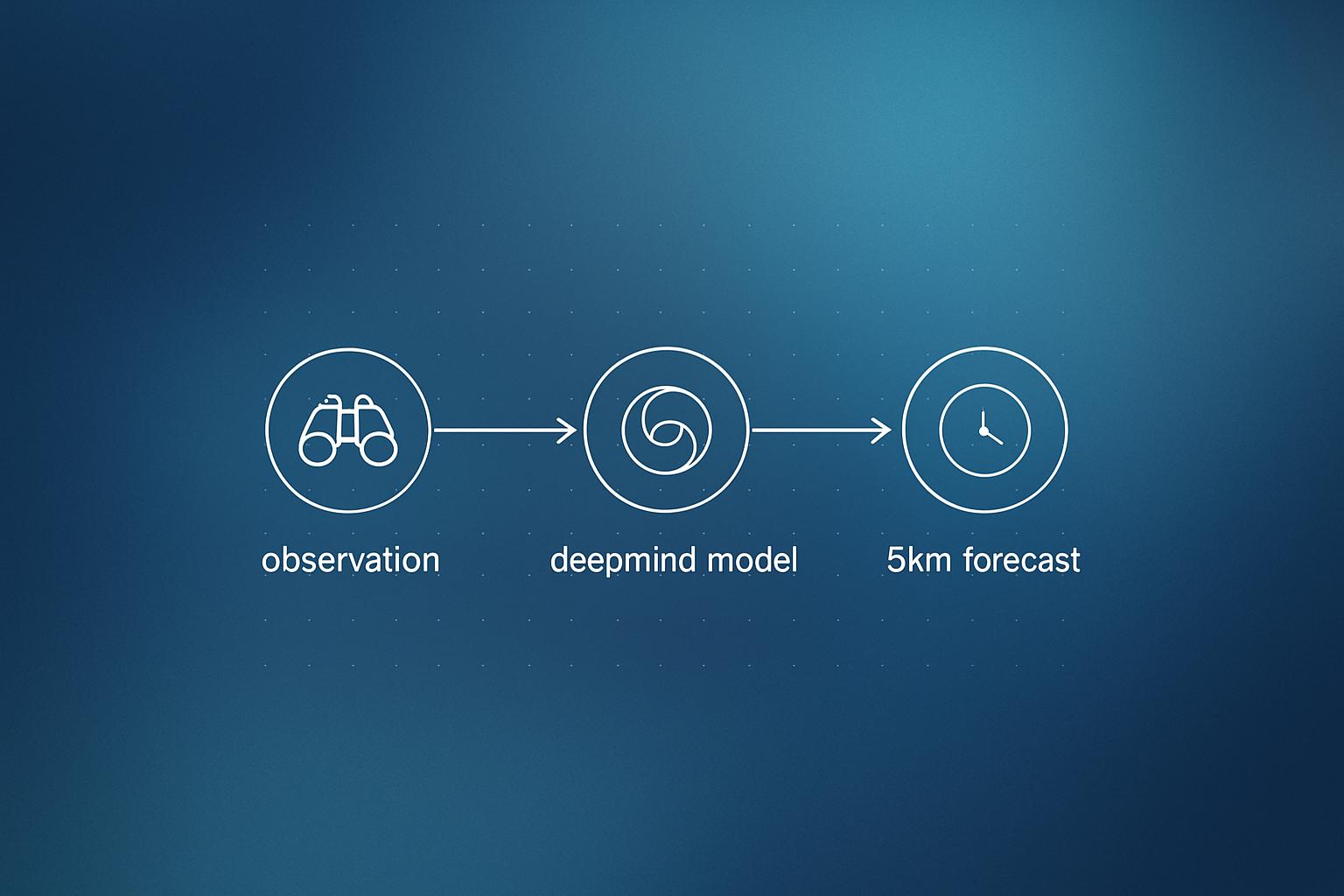
Google DeepMind and Google Research have released WeatherNext 3, a global weather forecasting model that produces outputs at 0.05 degrees (roughly 5 km) resolution and re-initializes every hour using live geostationary satellite data. It trains on raw weather station measurements alongside reanalysis data, making its temperature and dew point outputs more calibrated to what instruments actually record. According to Google AI, independent live evaluations from Brightband rank it as the most accurate global weather model to date. Forecast data is available now by allowlist request; the model weights remain closed.
What happened
| Detail | Spec |
|---|---|
| Finest resolution | 0.05° (~5 km) for 2 m temperature and dew point |
| Intermediate resolution | 0.1° (~10 km) for surface wind, pressure, SST, cloud, solar, precip |
| Coarse resolution | 0.25° (~25 km) for 13 atmospheric pressure levels |
| Initialization cadence | Every hour (24 times per day) |
| Forecast horizon (synoptic) | 15 days / 360 hours at 00, 06, 12, 18 UTC |
| Forecast horizon (hourly runs) | 48 hours |
| Ensemble members | 64 (synoptic runs) |
| Precipitation CRPS improvement | Up to 60% vs. IMERG at early lead times |
| Data access | BigQuery, Earth Engine, Cloud Storage (allowlist) |
| Model weights | Closed (not open source) |
WeatherNext 3 is built on the same Functional Generative Network (FGN) mesh transformer architecture introduced with WeatherNext 2, a probabilistic model family designed for multi-resolution output. Its primary inputs are a live global geostationary satellite mosaic and ECMWF HRES analysis. Training draws on ERA5/HRES-fc0 reanalysis, NASA’s IMERG satellite precipitation data, station observations, and satellite mosaics.
The biggest structural change from WeatherNext 2 is how the model handles local terrain. Most AI weather models learn from NWP reanalysis grids, which smooth out the variation that coastlines, valleys, and mountains create. WeatherNext 3 adds dedicated observational heads trained directly on raw station measurements, so its finest-resolution outputs are calibrated to instrument readings rather than a model’s approximation of those readings.
WeatherNext 2 produced 0.25° fields in 6-hour increments. The new model’s 0.05° finest tier is roughly 5x sharper, and the hourly re-initialization replaces the roughly six-hour lag that NWP analysis previously introduced.
Why does the hourly cadence matter for fast-moving weather?
For fast-developing storms (convection), a forecast re-anchored to current satellite imagery every hour is meaningfully different from one anchored to analysis that is already six hours old. That gap is where NWP-based forecasts have historically struggled with rapidly intensifying systems.
Precipitation is where global models have long performed worst, producing blurry fields that miss storm edges. WeatherNext 3 trains against three separate precipitation sources: ECMWF reanalysis, NASA’s IMERG satellite retrievals, and Google’s own satellite-radar precipitation reanalysis. According to Google, the model achieves up to 60% CRPS improvement against IMERG, up to 30% against MRMS, and up to 10% against rain gauges at early lead times. A separate evaluation reports up to a 50% reduction in Brier score and CRPS versus NWP baselines when measured against IMERG.
Who is this actually built for?
The renewable energy outputs are the clearest signal about the target customer. WeatherNext 3 produces 100 m wind speed at roughly turbine hub height, full low/medium/high cloud distributions, and both solar irradiance components (SSRD and FDIR). That combination is what grid operators and energy traders need to forecast wind and solar generation against demand curves.
Access today is through Google Cloud. Forecast data is available via BigQuery, Earth Engine, and Cloud Storage after an allowlist request. On-demand custom inference still runs on WeatherNext 2 while the newer model rolls out. The weights are not open source, so teams cannot self-host or fine-tune.
Our take
The resolution and cadence improvements are real and measurable. Going from 0.25° every six hours to 0.05° every hour is not incremental for anyone who needs local precision, such as energy, agriculture, insurance, or logistics operators. The precipitation numbers are the most credible headline because Google benchmarks against three independent sources rather than a single internal metric.
That said, the closed-weights decision limits how widely this can be adopted or audited. Researchers and smaller operators cannot reproduce or validate results independently without going through Google’s Cloud allowlist. For enterprise buyers already on Google Cloud infrastructure, that friction may be low. For everyone else, it is a real constraint. The parallel with how Google DeepMind structures its other applied AI programs is worth noting: the research gets published, the model stays inside Google’s stack.
If your business runs any kind of weather-sensitive operation, requesting allowlist access now costs nothing. If you are evaluating AI integration for operational forecasting, this is worth testing against your current NWP or commercial data provider. Our AI integration work regularly involves connecting external model APIs to operational dashboards, and the BigQuery interface here is a practical entry point for that kind of build.
What to do about it
- Request allowlist access through Google Cloud to start pulling WeatherNext 3 forecast data into your environment.
- Compare the 0.05° temperature and dew point outputs against your current weather data source for your specific geography, especially if you operate near coastlines, mountains, or valleys.
- If you use weather data for energy, logistics, or agriculture planning, test the 100 m wind and solar irradiance outputs against your existing forecasting pipeline.
- Monitor when WeatherNext 3 weights become available for custom inference, since on-demand inference currently defaults to WeatherNext 2.
For businesses that depend on accurate local forecasts, the allowlist request is the one concrete action available right now.
Frequently asked questions
What resolution does WeatherNext 3 produce?
WeatherNext 3 outputs three tiers in a single forward pass: 0.05 degrees (about 5 km) for 2 m temperature and dew point, 0.1 degrees (about 10 km) for surface variables including wind and precipitation, and 0.25 degrees (about 25 km) for atmospheric fields across 13 pressure levels.
How often does WeatherNext 3 update its forecasts?
The model re-initializes every hour, 24 times per day. The four main synoptic cycles (00, 06, 12, 18 UTC) run out to 15 days with 64 ensemble members; the interim hourly runs cover 48 hours.
Can I download WeatherNext 3 model weights?
No. The model weights are not open source. Forecast data is available via BigQuery, Earth Engine, and Cloud Storage on Google Cloud after an allowlist request, but custom on-demand inference currently runs on WeatherNext 2.
How much better is WeatherNext 3 at precipitation forecasting?
According to Google, WeatherNext 3 achieves up to 60% improvement in CRPS score against NASA IMERG, up to 30% against MRMS, and up to 10% against rain gauges at early lead times. A separate evaluation reports up to 50% reduction in Brier score versus NWP baselines when measured against IMERG.