ChatGPT, Claude, Grok, and Gemini All Went Down at Once on Sept. 3
ChatGPT, Claude, Grok, Gemini, and Cursor all went down within the same 30-minute window on Sept. 3, 2026. ChatGPT drew 340,000+ Downdetector reports.
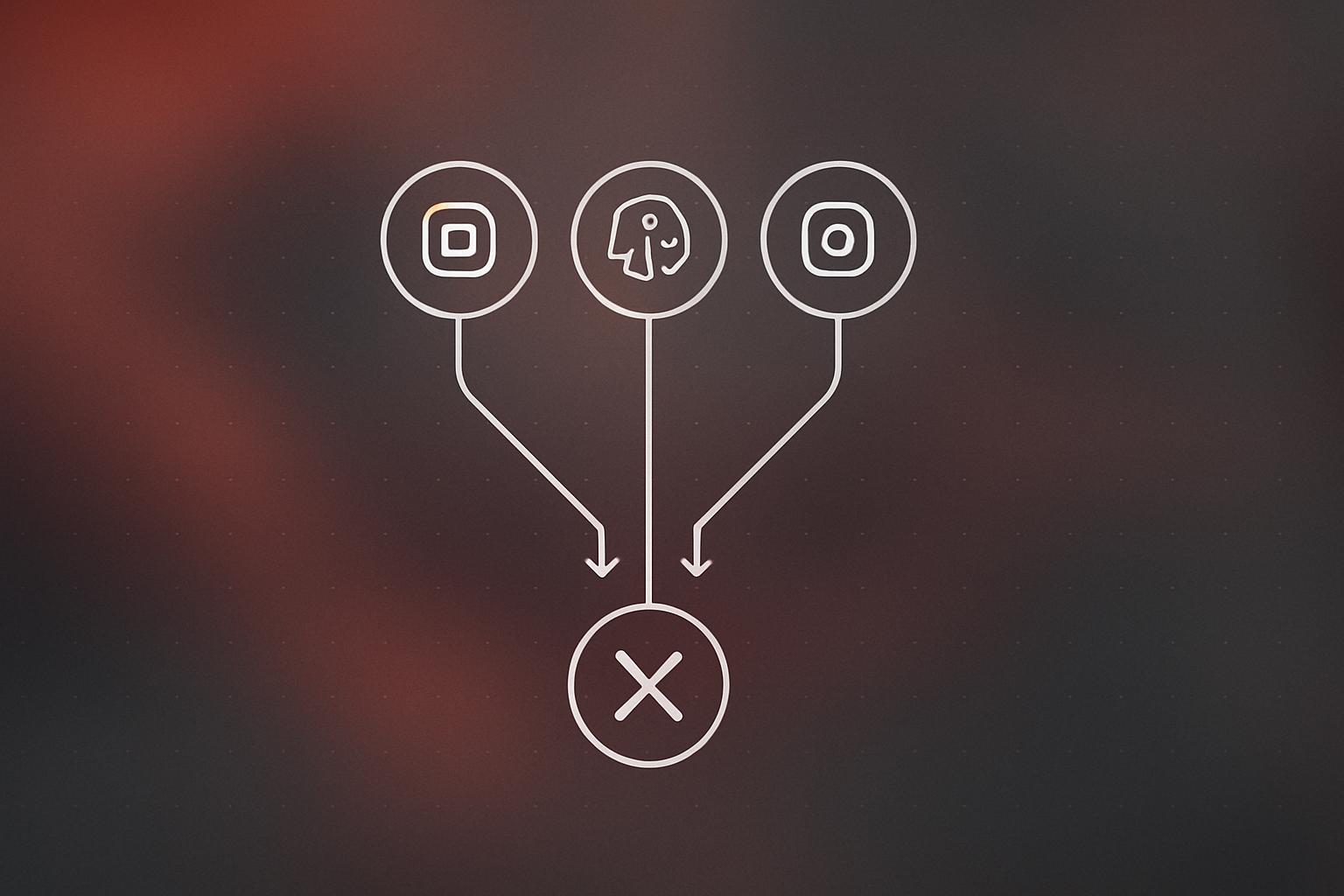
On Thursday, September 3, 2026, ChatGPT, Claude, Grok, Gemini, and the AI coding tool Cursor all reported service problems within roughly the same 30-minute window. ChatGPT drew more than 340,000 reports on Downdetector, the platform's largest reported outage in over a year. Services began recovering around 8:49 a.m. Pacific time, with full restoration confirmed across ChatGPT, Claude, and Grok by 12:38 p.m. Pacific. No shared root cause connecting the simultaneous failures was publicly identified by any of the companies involved.
What happened
| Data point | Detail |
|---|---|
| Date | Thursday, September 3, 2026 |
| ChatGPT outage start | ~10:58 a.m. ET |
| ChatGPT components affected | 15 (login, search, image generation, voice mode, Deep Research, plus 4 Codex components) |
| Downdetector reports for ChatGPT | More than 340,000 globally |
| Claude models affected | Opus 5, Opus 4.8, Opus 4.6 |
| Grok cause (per SpaceX) | Computing center outage in Memphis, Tennessee |
| OpenAI’s stated cause | Routing error, fixed within ~1 hour |
| Recovery confirmed | 12:38 p.m. Pacific time (ChatGPT, Claude, Grok) |
Five major AI platforms went offline in the same narrow time window on September 3. According to outage-tracking site Downdetector, the ChatGPT disruption alone generated more than 340,000 reports globally, making it the platform’s largest recorded outage by report volume in over a year.
OpenAI’s status page logged the ChatGPT outage starting around 10:58 a.m. ET, with 15 separate components going down: login, search, image generation, voice mode, Deep Research, and four components of Codex. OpenAI later described the underlying problem as a routing error that the company said it resolved in roughly one hour.
Claude, Grok, and Cursor
Anthropic’s Claude suffered elevated error rates affecting Opus 5, Opus 4.8, and Opus 4.6 at around the same time. The disruption hit the Claude.ai web interface, Anthropic’s developer API, and its Claude Code and Claude Cowork products. Most Claude models returned to baseline error rates relatively quickly, though some of the more advanced models stayed degraded for longer.
Grok, the chatbot from Elon Musk’s xAI, was taken down by an outage at a SpaceX computing center in Memphis, Tennessee, affecting both the web application and API across two separate regions. Cursor, a popular AI coding assistant that pulls from multiple model providers, cited the concurrent Grok and Claude issues as the direct cause of its own service problems.
Gemini’s narrower disruption
Google’s Gemini saw a Downdetector spike and users reported connection timeouts and internal server errors, but Google never issued an official outage confirmation. Google AI Studio’s status page noted a partial degradation affecting newly created API keys specifically, which Google categorized as a partial issue rather than a full platform failure.
Why it matters
It is genuinely unusual for services running on distinct backend infrastructure, built by rival companies, to fail within the same 30-minute window. None of OpenAI, Anthropic, or xAI published a detailed post-mortem identifying a shared cause. No infrastructure vendor, no denial-of-service attack, and no common configuration bug was named publicly.
That silence is notable. Businesses that have wired AI tools directly into their workflows, for customer support, content production, sales automation, or code review, had those workflows stop cold for several hours. The incident puts a spotlight on a dependency risk that many teams have not formally planned for.
This is part of a broader pattern. According to the source, 2026 has already seen several major single-vendor AI outages, including a Claude-specific disruption in June that lasted approximately seven hours. Thursday was unusual because it hit multiple providers at once, not just one.
For teams thinking through AI integration for production workflows, resilience planning is no longer an edge-case concern. It is a core design question.
Our take
We have watched clients build meaningful parts of their operations around a single AI API without any fallback plan. Thursday is the clearest argument yet for why that is a liability. When one provider goes down, it is a bad afternoon. When four go down at once and nobody can explain why, it is a reminder that the infrastructure underpinning these tools is still maturing, regardless of what the marketing says.
The fact that no common cause was identified is the most interesting detail here. It might mean the failures were truly coincidental, which itself says something about how fragile the moment is. Or it might mean there is a shared dependency no company wants to talk about publicly. Either way, the answer is the same: do not let a single provider be a single point of failure in a workflow that matters.
If you are tracking how the AI reliability picture is developing, our AI news coverage keeps a running record of incidents like this one.
What to do about it
- Audit every workflow that calls an external AI API and mark it as a dependency risk.
- Implement timeout thresholds and automated fallback logic so operations do not stall when a provider is unavailable.
- Evaluate a locally hosted open-source model as a fallback for the highest-priority tasks during cloud outages.
- Build a simple monitoring alert (via your existing status-page subscriptions) so your team knows about an outage before users do.
- Document a manual workaround for each AI-dependent step so staff know what to do when the tools are unavailable.
The teams least affected by Thursday’s outage were the ones who had already treated AI availability like any other third-party API: with a plan B ready to go.
Frequently asked questions
Why did ChatGPT, Claude, Grok, and Gemini all go down at the same time?
No shared root cause was publicly identified. OpenAI attributed its outage to a routing error. SpaceX traced Grok's failure to a computing center outage in Memphis, Tennessee. Anthropic did not name a specific cause for Claude's disruption. No infrastructure vendor or common configuration bug was named as a connecting factor.
How long was ChatGPT down on September 3, 2026?
ChatGPT began experiencing issues around 10:58 a.m. ET. OpenAI said its routing error was fixed within about one hour, and full restoration across ChatGPT, Claude, and Grok was confirmed by 12:38 p.m. Pacific time.
How many Downdetector reports did the ChatGPT outage get?
More than 340,000 reports were filed on Downdetector, making it the platform's largest outage by report volume in more than a year.
Which Claude models were affected by the September 3 outage?
Anthropic's status dashboard listed Opus 5, Opus 4.8, and Opus 4.6 as the affected models, with disruptions hitting the Claude.ai web interface, the developer API, and Claude Code and Claude Cowork products.